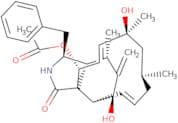
CAS 53760-19-3
:Cytochalasin H
Description:
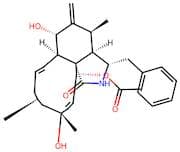
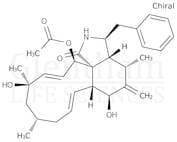
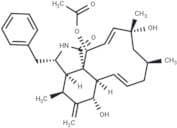
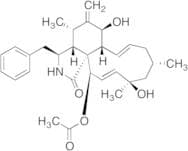
Cytochalasin H is a natural product belonging to the cytochalasin family, which are known for their ability to inhibit cell division and affect cytoskeletal dynamics. It is derived from certain fungi, particularly from the genus *Helminthosporium*. The compound is characterized by its complex structure, which includes a lactone ring and multiple functional groups that contribute to its biological activity. Cytochalasin H is primarily recognized for its role as a potent inhibitor of actin polymerization, thereby disrupting the normal function of the cytoskeleton in eukaryotic cells. This disruption can lead to various cellular effects, including altered cell shape, motility, and division. Due to its ability to modulate cellular processes, Cytochalasin H has been utilized in research to study cell biology, particularly in the context of cancer and developmental biology. However, its use is often limited to laboratory settings due to its potent biological effects and potential toxicity. As with many cytochalasins, it is important to handle Cytochalasin H with care, following appropriate safety protocols.
Formula:C30H39NO5
InChI:InChI=1/C30H39NO5/c1-18-10-9-13-23-27(33)20(3)19(2)26-24(16-22-11-7-6-8-12-22)31-28(34)30(23,26)25(36-21(4)32)14-15-29(5,35)17-18/h6-9,11-15,18-19,23-27,33,35H,3,10,16-17H2,1-2,4-5H3,(H,31,34)/b13-9+,15-14+/t18-,19+,23-,24-,25+,26-,27+,29+,30?/m0/s1
InChI key:InChIKey=NAEWXXDGBKTIMN-OWTACEMYSA-N
SMILES:O(C(C)=O)[C@H]/1[C@]23[C@]([C@H](CC4=CC=CC=C4)NC2=O)([C@H](C)C(=C)[C@@H](O)[C@@]3(/C=C/C[C@H](C)C[C@@](C)(O)\C=C1)[H])[H]
Synonyms:- (3S,3aR,4S,6S,6aR,7E,10S,12R,13E,15R,15aR)-15-(Acetyloxy)-2,3,3a,4,5,6,6a,9,10,11,12,15-dodecahydro-6,12-dihydroxy-4,10,12-trimethyl-5-methylene-3-(phenylmethyl)-1H-cycloundec[d]isoindol-1-one
- (3S,3aR,4S,6S,6aR,7E,10S,12S,13E,15R)-3-benzyl-6,12-dihydroxy-4,10,12-trimethyl-5-methylidene-1-oxo-2,3,3a,4,5,6,6a,9,10,11,12,15-dodecahydro-1H-cycloundeca[d]isoindol-15-yl acetate
- 1H-Cycloundec[d]isoindol-1-one, 15-(acetyloxy)-2,3,3a,4,5,6,6a,9,10,11,12,15-dodecahydro-6,12-dihydroxy-4,10,12-trimethyl-5-methylene-3-(phenylmethyl)-, (3S,3aR,4S,6S,6aR,7E,10S,12R,13E,15R,15aR)-
- 1H-Cycloundec[d]isoindol-1-one, 15-(acetyloxy)-2,3,3a,4,5,6,6a,9,10,11,12,15-dodecahydro-6,12-dihydroxy-4,10,12-trimethyl-5-methylene-3-(phenylmethyl)-, [3S-(3R*,3aS*,4R*,6R*,6aS*,7E,10R*,12S*,13E,15S*,15aS*)]-
- Cytochalasin H
- Cytochalasin O
- Cytochalasin�H from Phomopsis sp.
- Kodocytochalasin 1
- Paspalin P I
- [11]Cytochalasa-6(12),13,19-trien-1-one, 21-(acetyloxy)-7,18-dihydroxy-16,18-dimethyl-10-phenyl-, (7S,13E,16S,18R,19E,21R)-
- cytochalasin H from A phomopsis species
Sort by
Purity (%)
0
100
|
0
|
50
|
90
|
95
|
100
Found 5 products.
Cytochalasin H
CAS:Formula:C30H39NO5Purity:≥ 98.0%Color and Shape:White to off-white solidMolecular weight:493.6Cytochalasin H
CAS:Cytochalasin H ((16-Benzyl-5,12-dihydroxy-5,7,14-trimethyl-13-methylidene-18-oxo-17-azatricyclo[9.7.0.01,15]octadeca-3,9-dien-2-yl) acetate) is a potent
Formula:C30H39NO5Purity:98.04%Color and Shape:SolidMolecular weight:493.63Ref: TM-T21513
1mg97.00€2mg142.00€5mg226.00€10mg340.00€25mg553.00€50mg735.00€100mg1,008.00€200mg1,359.00€Cytochalasin H (>90%)
CAS:Applications Cytochalasin H is a cell-permeable fungal toxin used in actin polymerization studies and cytological research. Isolated from the solid fermentate of Phomopsis theicola, an endophytic fungus isolated from the leaves of an endemic Formosan plant Litsea hypophaea Hayata. It is also a progesterone receptor antagonist.
Not a dangerous good if item is equal to or less than 1g/ml and there is less than 100g/ml in the package
References Hsiao, Y., et al.: Rec. Nat. Prod., 10, 189-194 (2016)Formula:C30H39NO5Purity:>90%Color and Shape:Off-WhiteMolecular weight:493.63Cytochalasin H
CAS:Fungal metabolite; inhibits actin polymerisationFormula:C30H39NO5Purity:Min. 95%Molecular weight:493.63 g/mol