CAS 53942-45-3
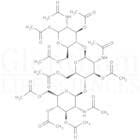
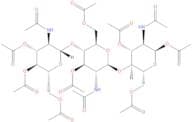
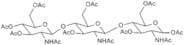
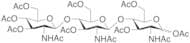
:[(3S,4R,5S,6S)-5-acetamido-3-[(2S,3S,4R,5S)-3-acetamido-4,5-diacetoxy-6-(acetoxymethyl)tetrahydropyran-2-yl]oxy-6-[(3S,4R,5S,6S)-5-acetamido-4,6-diacetoxy-2-(acetoxymethyl)tetrahydropyran-3-yl]oxy-4-acetoxy-tetrahydropyran-2-yl]methyl acetate
Description:
The chemical substance with the name "[(3S,4R,5S,6S)-5-acetamido-3-[(2S,3S,4R,5S)-3-acetamido-4,5-diacetoxy-6-(acetoxymethyl)tetrahydropyran-2-yl]oxy-6-[(3S,4R,5S,6S)-5-acetamido-4,6-diacetoxy-2-(acetoxymethyl)tetrahydropyran-3-yl]oxy-4-acetoxy-tetrahydropyran-2-yl]methyl acetate" and CAS number "53942-45-3" is a complex organic compound characterized by its multiple functional groups, including acetamido and acetoxy moieties. This compound features a tetrahydropyran backbone, which is a six-membered cyclic ether, and exhibits stereochemical specificity with several chiral centers, indicating that it exists in specific stereoisomeric forms. The presence of multiple acetoxy groups suggests potential reactivity and applications in organic synthesis or medicinal chemistry. Its structural complexity may contribute to unique biological activities, making it of interest in pharmaceutical research. Additionally, the compound's solubility, stability, and reactivity can be influenced by its functional groups and stereochemistry, which are critical for understanding its behavior in various chemical environments.
Formula:C40H57N3O24
InChI:InChI=1/C40H57N3O24/c1-15(44)41-29-36(60-23(9)52)33(27(13-56-19(5)48)63-38(29)62-25(11)54)66-40-31(43-17(3)46)37(61-24(10)53)34(28(65-40)14-57-20(6)49)67-39-30(42-16(2)45)35(59-22(8)51)32(58-21(7)50)26(64-39)12-55-18(4)47/h26-40H,12-14H2,1-11H3,(H,41,44)(H,42,45)(H,43,46)/t26?,27?,28?,29-,30-,31-,32+,33+,34+,35+,36+,37+,38+,39-,40-/m0/s1
Synonyms:- O-3,4,6-Tri-O-acetyl-2-(acetylamino)-2-deoxy-b-D-glucopyranosyl-(1-4)-O-3,6-di-O-acetyl-2-(acetylamino)-2-deoxy-b-D-glucopyranosyl-(1-4)-2-(acetylamino)-2-deoxy-1,3,6-triacetate-a-D-glucopyranose
- Tri-N-acetyl Chitotriose Octaac
- O-3,4,6-Tri-O-acetyl-2-(acetylamino)-2-deoxy--D-glucopyranosyl-(1-4)-O-3,6-di-O-acetyl-2-(acetylamino)-2-deoxy--D-glucopyranosyl-(1-4)-2-(acetylamino)-2-deoxy-1,3,6-triacetate-a-D-glucopyranose
- α-D-Glucopyranose, O-3,4,6-tri-O-acetyl-2-(acetylamino)-2-deoxy-β-D-glucopyranosyl-(1→4)-O-3,6-di-O-acetyl-2-(acetylamino)-2-deoxy-β-D-glucopyranosyl-(1→4)-2-(acetylamino)-2-deoxy-, 1,3,6-triacetate
- Tri-N-acetyl Chitotriose Octaacetate
- O-3,4,6-Tri-O-acetyl-2-(acetylaMino)-2-deoxy-β-D-glucopyranosyl-(1-4)-O-3,6-di-O-acetyl-2-(acetylaMino)-2-deoxy-β-D-glucopyranosyl-(1-4)-2-(acetylaMino)-2-deoxy-1,3,6-triacetate-α-D-glucopyranose
Sort by
Purity (%)
0
100
|
0
|
50
|
90
|
95
|
100
Found 4 products.
Chitotriose undecaacetate
CAS:Chitotriose undecaacetate is a synthetic substrate that is used in transfecting experiments. It has high sensitivity and can be used to introduce nucleic acid into cells. Chitotriose undecaacetate is used as a synthetic fluorometric assay for the determination of chitinase activity in vitro or as a substrate for cell-free synthesis of nucleic acids. It has been shown to possess moieties that are sensitive to hydrogen chloride and chloride ions, making it an effective probe for the determination of these ions. Chitotriose undecaacetate also reacts with sephadex G-200, which makes it useful for separating DNA fragments by electrophoresis.Formula:C40H57N3O24Purity:Min. 95%Color and Shape:White PowderMolecular weight:963.89 g/molChitotriose Undecaacetate
CAS:Controlled ProductApplications An intermediate of 4-Methylumbelliferyl β-D-N,N',N”-Triacetylchitotrioside.
References Yang, Y., et al.: J. Biochem., 87, 1003 (1980)Formula:C40H57N3O24Color and Shape:NeatMolecular weight:963.89