CAS 54-35-3
:Penicillin G procaine
Description:
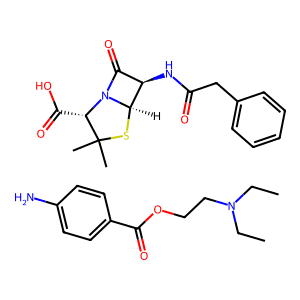
Penicillin G procaine, with the CAS number 54-35-3, is a semi-synthetic antibiotic that combines penicillin G with procaine to enhance its pharmacological properties. This compound is characterized by its broad-spectrum antibacterial activity, primarily effective against gram-positive bacteria and some gram-negative organisms. It is typically administered via intramuscular injection due to its poor oral bioavailability. The procaine component serves to prolong the action of penicillin G by slowing its release into the bloodstream, thus allowing for extended therapeutic effects. Penicillin G procaine is commonly used in the treatment of various bacterial infections, including respiratory tract infections, skin infections, and certain types of syphilis. Its formulation is designed to minimize the risk of allergic reactions associated with penicillin, although hypersensitivity can still occur in some individuals. As with other penicillins, it works by inhibiting bacterial cell wall synthesis, leading to cell lysis and death. Proper storage and handling are essential to maintain its efficacy, as it is sensitive to heat and moisture.
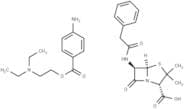
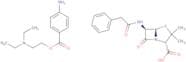
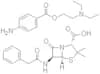
Formula:C16H18N2O4S·C13H20N2O2
InChI:InChI=1S/C16H18N2O4S.C13H20N2O2/c1-16(2)12(15(21)22)18-13(20)11(14(18)23-16)17-10(19)8-9-6-4-3-5-7-9;1-3-15(4-2)9-10-17-13(16)11-5-7-12(14)8-6-11/h3-7,11-12,14H,8H2,1-2H3,(H,17,19)(H,21,22);5-8H,3-4,9-10,14H2,1-2H3/t11-,12+,14-;/m1./s1
InChI key:InChIKey=WHRVRSCEWKLAHX-LQDWTQKMSA-N
SMILES:C(O)(=O)[C@@H]1N2[C@@]([C@H](NC(CC3=CC=CC=C3)=O)C2=O)(SC1(C)C)[H].C(OCCN(CC)CC)(=O)C1=CC=C(N)C=C1
Synonyms:- (2S,5R,6R)-3,3-dimethyl-7-oxo-6-[(phenylacetyl)amino]-4-thia-1-azabicyclo[3.2.0]heptane-2-carboxylic acid-2-(diethylamino)ethyl 4-aminobenzoate (1:1)
- (2S,5R,6R)-3,3-dimethyl-7-oxo-6-[(phenylacetyl)amino]-4-thia-1-azabicyclo[3.2.0]heptane-2-carboxylic acid-2-(diethylamino)ethyl 4-aminobenzoate hydrate (1:1:1)
- 3,3-Dimethyl-7-Oxo-6-[(Phenylacetyl)Amino]-4-Thia-1-Azabicyclo[3.2.0]Heptane-2-Carboxylic Acid-2-(Diethylamino)Ethyl 4-Aminobenzoate (1:1)
- 4-Thia-1-azabicyclo[3.2.0]heptane-2-carboxylic acid, 3,3-dimethyl-7-oxo-6-(2-phenylacetamido)-, compd. with 2-(diethylamino)ethyl p-aminobenzoate (1:1)
- 4-Thia-1-azabicyclo[3.2.0]heptane-2-carboxylic acid, 3,3-dimethyl-7-oxo-6-[(2-phenylacetyl)amino]- (2S,5R,6R)-, compd. with 2-(diethylamino)ethyl 4-aminobenzoate (1:1)
- 4-Thia-1-azabicyclo[3.2.0]heptane-2-carboxylic acid, 3,3-dimethyl-7-oxo-6-[(phenylacetyl)amino]- (2S,5R,6R)-, compd. with 2-(diethylamino)ethyl 4-aminobenzoate (1:1)
- 4-Thia-1-azabicyclo[3.2.0]heptane-2-carboxylic acid, 3,3-dimethyl-7-oxo-6-[(phenylacetyl)amino]-[2S-(2α,5α,6β)]-, compd. with 2-(diethylamino)ethyl 4-aminobenzoate (1:1)
- Abbocillin DC
- Afsillin
- Ampin-penicillin
- Aquacilina
- Aquacillin
- Aquasuspen
- Avloprocil
- Benzoic acid, 4-amino-, 2-(diethylamino)ethyl ester, mono[(2S,5R,6R)-3,3-dimethyl-7-oxo-6-[(phenylacetyl)amino]-4-thia-1-azabicyclo[3.2.0]heptane-2-carboxylate]
- Benzoic acid, 4-amino-, 2-(diethylamino)ethyl ester, mono[[2S-(2α,5α,6β)]-3,3-dimethyl-7-oxo-6-[(phenylacetyl)amino]-4-thia-1-azabicyclo[3.2.0]heptane-2-carboxylate]
- Benzylpenicillin
- Benzylpenicillin Procaine
- Benzylpenicillin novocaine salt
- Benzylpenicillin procaine salt
- Carepen
- Cilicaine
- Crysticillin
- Depocillin
- Despacilina
- Distaquaine
- Dorsallin AR
- Duphapen
- Duracillin
- Ethacilin
- Flo-Cillin Aqueous
- Geepenil
- Hostacillin
- Hydracillin
- Ilcocillin P
- Jenacillin O
- Kabipenin
- Ledercillin
- Lenticillin
- Mammacillin
- Masticillin
- Megapen
- Micro-Pen
- Millicillin
- Mylipen
- Neoproc
- Nopcaine
- Novocaine penicillin
- Pen 50
- Pen-Fifty
- Penaquacaine G
- Penicillin G Procaine Sterile
- Penicillin G procaine
- Penicillin procaine
- Penovet
- Pentaquacaine G
- Penzal N 300
- Premocillin
- Pro-Pen
- Procain Penicillin G
- Procaine Benzylpenicillin
- Procaine benzylpenicillin salt
- Procaine benzylpenicillinate
- Procaine penicillin (G)
- Procanodia
- Prostabillin
- Retardillin
- Sharcillin
- Vetspen
- Vitablend
- Wycillin
- Sterile Penicillin G Procaine/SodiuM3∶1 API
- Benzylpenicillinic acid, procaine
- Penicillin G procaine Benzylpenicillin procaine API
- Procaine penicillin G(fortified) USP/EP/BP
- BENZYLPENICILLIN PROCAIN SALT
- PROCAINE BENZYLPENICILLIN (PROCAINE PENICILLIN) ASSAY STANDARD BP(CRM STANDARD)
- PENICILLIN-G PROCAIN SALT
- Penicillin G Procaine/Sodium 3:1 USP/EP/BP
- PROCAINE BENZYLPENICILLIN EPP(CRM STANDARD)
- Procaine penicillin G(1% lecithin/citrate acid)
- 4-Thia-1-azabicyclo3.2.0heptane-2-carboxylic acid, 3,3-dimethyl-7-oxo-6-(phenylacetyl)amino- (2S,5R,6R)-, compd. with 2-(diethylamino)ethyl 4-aminobenzoate (1:1)
- (2S,5R,6R)-3,3-dimethyl-7-oxo-6-[(1-oxo-2-phenylethyl)amino]-4-thia-1-azabicyclo[3.2.0]heptane-2-carboxylic acid
- Penicillin G procaine +1% lecithin CP200/BP/USP/EP
- Procain-Penicillin
- PENICILLIN G PROCAINE USP/EP/BP
- Penicillin G procaine sterile CP200/BP/USP/EP
- Procaine penicillin G USP/EP/BP
- BENZYLPENICILLIN PROCAINE + POTASSIC 3:1
- See more synonyms
Sort by
Purity (%)
0
100
|
0
|
50
|
90
|
95
|
100
Found 5 products.
Procaine benzylpenicillin
CAS:Procaine benzylpenicillinFormula:C13H20N2O2 / C13H20N2O2C16H18N2O4SH2OColor and Shape:White PowderMolecular weight:236.15248(2S,5R,6R)-3,3-dimethyl-7-oxo-6-(2-phenylacetamido)-4-thia-1-azabicyclo[3.2.0]heptane-2-carboxylic acid; 2-(diethylamino)ethyl 4-aminobenzoate
CAS:Formula:C29H38N4O6SPurity:98%Molecular weight:570.7002Procaine penicillin G
CAS:Procaine penicillin G treats syphilis, anthrax, oral infections, pneumonia, diphtheria, cellulitis, and bites.Formula:C29H38N4O6SPurity:99.73%Color and Shape:A White Crystalline PowderMolecular weight:570.7Penicillin G procaine
CAS:Controlled ProductPenicillin G procaine is a form of penicillin that is commonly used to treat bacterial infections. It is a prodrug that undergoes hydrolysis in the body to release penicillin, its active form. Penicillin G procaine has been shown to be effective against Streptococcus pyogenes, which causes streptococcal pharyngitis, and other bacteria that are sensitive to penicillin. Penicillin G procaine is less toxic than other forms of penicillin and has minimal side effects. The pharmacological effects of the drug are due primarily to the inhibition of bacterial cell wall synthesis by binding to peptidoglycan precursors and blocking their cross-linking. The concentration–time curve for penicillin G procaine shows that it has a long half-life in humans, making it suitable for continuous treatment in patients with chronic infections.Formula:C16H18N2O4S·C13H20N2O2Purity:Min. 95%Molecular weight:570.7 g/mol


![(2S,5R,6R)-3,3-dimethyl-7-oxo-6-(2-phenylacetamido)-4-thia-1-azabicyclo[3.2.0]heptane-2-carboxylic…](/_next/image/?url=https%3A%2Fstatic.cymitquimica.com%2Fproducts%2FIN%2Fthumb%2FDA00I9MZ.jpg&w=3840&q=75)