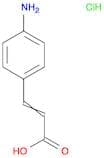
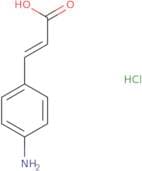
CAS 54057-95-3
:2-Propenoic acid, 3-(4-aminophenyl)-, hydrochloride (1:1)
Description:
2-Propenoic acid, 3-(4-aminophenyl)-, hydrochloride (1:1), commonly known as 4-aminostyrene acrylate hydrochloride, is an organic compound characterized by its acrylate structure, which features a propenoic acid backbone with an amino group attached to a phenyl ring. This compound typically appears as a white to off-white solid and is soluble in water due to the presence of the hydrochloride salt form, which enhances its solubility compared to the free base. The presence of the amino group imparts basic properties, allowing it to participate in various chemical reactions, including polymerization and coupling reactions. It is often utilized in the synthesis of polymers, dyes, and pharmaceuticals. The compound's reactivity is influenced by the double bond in the propenoic acid moiety, making it a valuable intermediate in organic synthesis. Safety data should be consulted for handling, as with many chemical substances, to ensure proper precautions are taken during use.
Formula:C9H9NO2·ClH
InChI:InChI=1S/C9H9NO2.ClH/c10-8-4-1-7(2-5-8)3-6-9(11)12;/h1-6H,10H2,(H,11,12);1H
InChI key:InChIKey=SFRAURMUQMJLPG-UHFFFAOYSA-N
SMILES:C(=CC(O)=O)C1=CC=C(N)C=C1.Cl
Synonyms:- 2-Propenoic acid, 3-(4-aminophenyl)-, hydrochloride
- 2-Propenoic acid, 3-(4-aminophenyl)-, hydrochloride (1:1)
- 3-(4-Aminophenyl)acrylic acid hydrochloride
- 4-Aminocinnamic acid hydrochloride
- p-Aminocinnamic acid hydrochloride
Sort by
Purity (%)
0
100
|
0
|
50
|
90
|
95
|
100
Found 3 products.
3-(4-Aminophenyl)acrylic acid hydrochloride
CAS:Formula:C9H10ClNO2Color and Shape:SolidMolecular weight:199.63424-Aminocinnamic acid hydrochloride
CAS:4-Aminocinnamic acid hydrochloride (4ACA) is a synthetic compound that inhibits the bacterial membrane by binding to the polypeptide chain of the protein. It is a water-soluble polymer that is capable of enhancing the water solubility of other compounds and has been shown to inhibit the growth of typhimurium. 4ACA binds to chalcone, anilines, and styrene, which are all substrates for bacterial enzymes. The interaction between 4ACA and these substrates alters their chemical properties and provides resistance to bacteria.Formula:C9H9NO2·HClPurity:Min. 95%Color and Shape:Off-White PowderMolecular weight:199.63 g/mol3-(4-Aminophenyl)acrylic acid hydrochloride
CAS:Formula:C9H10ClNO2Purity:95.0%Color and Shape:No data available.Molecular weight:199.63