CymitQuimica logo

CAS 5410-78-6

:

(4-aminophenyl)arsonous dichloride

Description:
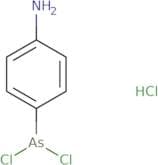
(4-Aminophenyl)arsonous dichloride, with the CAS number 5410-78-6, is an organoarsenic compound characterized by the presence of an arsonous (trivalent arsenic) functional group attached to a para-aminophenyl moiety. This compound typically appears as a solid and is known for its potential toxicity due to the presence of arsenic, which can pose significant health risks. The dichloride aspect indicates that two chlorine atoms are bonded to the arsenic atom, influencing its reactivity and solubility in various solvents. The presence of the amino group (-NH2) on the aromatic ring can participate in various chemical reactions, making this compound of interest in both synthetic organic chemistry and toxicological studies. Due to its arsenic content, it is crucial to handle this substance with care, adhering to safety protocols to mitigate exposure risks. Its applications may include research in pharmacology or materials science, but its use is often limited due to regulatory concerns surrounding arsenic compounds.
Formula:C6H6AsCl2N
InChI:InChI=1/C6H6AsCl2N/c8-7(9)5-1-3-6(10)4-2-5/h1-4H,10H2
SMILES:c1cc(ccc1[As](Cl)Cl)N
Synonyms:
  • arsonous dichloride, N-(4-aminophenyl)-
  • (4-Aminophenyl)arsonous dichloride
Sort by

Purity (%)
0
100
|
0
|
50
|
90
|
95
|
100
Found 1 products.
  • p-Aminophenyldichloroarsine hydrochloride

    CAS:
    <p>p-Aminophenyldichloroarsine hydrochloride (APD) is a reversible alkylating agent that binds to sulphydryls and reversibly inhibits the activity of nicotinic acetylcholine receptors. It is also an arsenical that has been shown to react with other proteins, such as acetylcholine receptor subunits. When it reacts with the acetylcholine receptor, it forms stable complexes and irreversible bonds. This prevents the receptor from functioning normally and leads to paralysis of muscles. The APD also binds to the reactive sites on DNA and blocks rRNA synthesis, leading to cell death.<br>APD is active against many bacteria, including Mycobacterium tuberculosis, but not against Gram-positive bacteria such as staphylococci or streptococci. It is also active against some fungi and protozoa but not against viruses.</p>
    Formula:C6H7AsCl3N
    Purity:Min. 95%
    Color and Shape:Powder
    Molecular weight:274.41 g/mol

    Ref: 3D-FA17825

    1g
    376.00€
    2g
    502.00€
    5g
    793.00€
    10g
    1,387.00€
    500mg
    250.00€