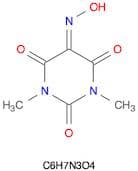
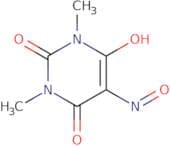
CAS 5417-13-0
:2,4,5,6(1H,3H)-Pyrimidinetetrone,1,3-dimethyl-, 5-oxime
Description:
2,4,5,6(1H,3H)-Pyrimidinetetrone, 1,3-dimethyl-, 5-oxime, with CAS number 5417-13-0, is a chemical compound that belongs to the class of pyrimidine derivatives. This substance features a pyrimidine ring, which is a six-membered heterocyclic structure containing two nitrogen atoms at positions 1 and 3. The presence of oxime functional groups indicates that it has a carbon-nitrogen double bond (C=N-OH), which can participate in various chemical reactions, including condensation and rearrangement. The dimethyl substitution at the 1 and 3 positions suggests that the compound may exhibit specific steric and electronic properties, influencing its reactivity and potential applications. Pyrimidine derivatives are often studied for their biological activity, including antimicrobial and antiviral properties. The compound's solubility, stability, and reactivity can vary based on the specific functional groups and substituents present. As with many organic compounds, safety data should be consulted to understand its handling and potential hazards in laboratory settings.
Formula:C6H7N3O4
Synonyms:- 5-Hydroxyimino-1,3-Dimethyl-1,3-Diazinane-2,4,6-Trione
- Alloxan,1,3-dimethyl-, 5-oxime
- Alloxan, dimethyl-, 5-oxime
- 1,3-Dimethylvioluric acid
- Dimethylvioluric acid
- Nsc 14273
- Nsc 7370
Sort by
Purity (%)
0
100
|
0
|
50
|
90
|
95
|
100
Found 3 products.
1,3-Dimethylvioluric acid
CAS:Formula:C6H7N3O4Purity:95%Color and Shape:SolidMolecular weight:185.13755-hydroxyimino-1,3-dimethyl-1,3-diazinane-2,4,6-trione
CAS:5-hydroxyimino-1,3-dimethyl-1,3-diazinane-2,4,6-trione1,3-Dimethylvioluric acid
CAS:1,3-Dimethylvioluric acid is a molecule that has been shown to reduce the size of experimental animal models of ventricular myocardium. It also increases the levels of atp and urea nitrogen in the heart, suggesting an increase in cardiac function. This molecule may be used to help prevent or treat cardiovascular diseases such as heart failure. 1,3-Dimethylvioluric acid has also been shown to have pluripotent cell properties and can be used to generate cells that are capable of differentiating into other types of cells. The effective dose for 1,3-dimethylvioluric acid is not known.
Formula:C6H7N3O4Purity:Min. 95%Color and Shape:White PowderMolecular weight:185.14 g/mol