CAS 54197-66-9
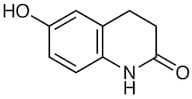
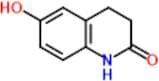
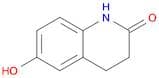
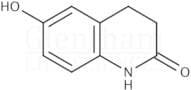
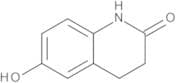
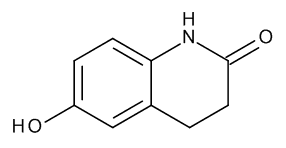
:6-Hydroxy-3,4-dihydro-2(1H)-quinolinone
Description:
6-Hydroxy-3,4-dihydro-2(1H)-quinolinone, with the CAS number 54197-66-9, is a chemical compound that belongs to the class of quinolinones, which are bicyclic compounds containing a quinoline ring fused with a lactam. This substance is characterized by the presence of a hydroxyl group at the 6-position and a saturated dihydro structure, which contributes to its unique chemical properties. It typically exhibits moderate solubility in polar solvents due to the hydroxyl group, while its aromatic nature may allow for interactions with various biological targets. The compound may possess biological activity, making it of interest in medicinal chemistry and pharmacology. Its structural features suggest potential applications in drug development, particularly in the synthesis of derivatives that could enhance therapeutic efficacy. Additionally, the compound's stability and reactivity can be influenced by the presence of functional groups, making it a subject of study in organic synthesis and material science.
Formula:C9H9NO2
InChI:InChI=1S/C9H9NO2/c11-7-2-3-8-6(5-7)1-4-9(12)10-8/h2-3,5,11H,1,4H2,(H,10,12)
InChI key:InChIKey=HOSGXJWQVBHGLT-UHFFFAOYSA-N
SMILES:OC=1C=C2C(NC(=O)CC2)=CC1
Synonyms:- 2(1H)-Quinolinone, 3,4-dihydro-6-hydroxy-
- 2-Oxo-1,2,3,4-tetrahydroquinolin-6-ol
- 3,4-Dihydro-6-hydroxy-2-[1H]-quinolinone
- 3,4-Dihydro-6-hydroxycarbostyril
- 3,4-Dihydroquinoline-2,6-diol
- 6-Hydroxy-1,2,3,4-tetrahydro-2-quinolinone
- 6-Hydroxy-2(1H)-3,4-Dihydroquinolinone
- 6-Hydroxy-2-Oxo-1,2,3,4-Tetrahydro Quinoline
- 6-Hydroxy-2-Oxo-1,2,3,4-Tetrahydroquinoline (6-Hq)
- 6-Hydroxy-2-oxo-1,2,3,4-tetrahydroquinoline
- 6-Hydroxy-3,4-dihydro carbostilyl
- 6-Hydroxy-3,4-dihydro-1H-quinolin-2-one
- 6-Hydroxy-3,4-dihydrocarbostyril
- 6-Hydroxy-3,4-dihydroquinazolone
- 6-Hydroxyl-3.4-dihydro-2-(1H)-quinolinone
- 6-hydroxy-3,4-dihydro-2(1H)-quinolinone
- 6-hydroxy-3,4-dihydroquinolin-2(1H)-one
- Carbostyril, 3,4-dihydro-6-hydroxy-
- See more synonyms
Sort by
Purity (%)
0
100
|
0
|
50
|
90
|
95
|
100
Found 11 products.
3,4-Dihydro-6-hydroxy-2(1H)-quinolinone
CAS:Formula:C9H9NO2Purity:>98.0%(HPLC)(N)Color and Shape:White to Almost white powder to crystalMolecular weight:163.18Cilostazol Related Compound A (6-hydroxy-3,4-dihydro-1H-quinolin-2-one)
CAS:Lactams not elsewhere specified or includedFormula:C9H9NO2Color and Shape:Yellow White PowderMolecular weight:163.063333,4-Dihydro-6-hydroxy-2(1H)-quinolinone
CAS:Formula:C9H9NO2Purity:98%Color and Shape:SolidMolecular weight:163.17336-Hydroxy-2-oxo-1,2,3,4-tetrahydroquinoline
CAS:Formula:C9H9NO2Purity:≥ 98.0%Color and Shape:White to off-white crystalline powderMolecular weight:163.176-Hydroxy-3,4-dihydro-1H-quinolin-2-one
CAS:Controlled ProductFormula:C9H9NO2Color and Shape:NeatMolecular weight:163.173,4-Dihydro-6-hydroxyquinolin-2(1H)-one
CAS:3,4-Dihydro-6-hydroxyquinolin-2(1H)-onePurity:98%Molecular weight:163.17g/mol6-Hydroxy-3,4-dihydro-1H-quinoline-2-one
CAS:Controlled ProductImpurity Cilostazol USP Related Compound A
Applications A metabolite of Cilostazole.
References Gitto, R., et al.: J. Med. Chem., 46, 3758 (2003), Xie, Z., et al.: Bioorg. Med. Chem. Lett., 15, 4803 (2005),Formula:C9H9NO2Color and Shape:NeatMolecular weight:163.176-Hydroxy-2-oxo-1,2,3,4-tetrahydroquinoline
CAS:Formula:C9H9NO2Purity:97%Color and Shape:SolidMolecular weight:163.1766-Hydroxy-3,4-dihydro-1H-quinoline-2-one
CAS:This is a quinoline derivative that has been shown to have inotropic and cardioprotective effects. It has been shown to increase the duration of action potentials and contractions in isolated heart muscle, as well as to improve the function of the heart by reducing the rate of myocardial oxygen consumption. 6-Hydroxy-3,4-dihydro-1H-quinoline-2-one has been shown to have anti-inflammatory properties and may be useful for treating respiratory diseases such as asthma. This compound is also used as a precursor for some pharmaceutical drugs, including chloroquine, mefloquine, amodiaquine, and primaquine. The compound is metabolized into conjugates that are recycled back into the body or excreted in human urine; this process is regulated by the balance between conjugation reactions and hydrolysis reactions.Formula:C9H9NO2Purity:Min. 95%Molecular weight:163.17 g/mol