CAS 5437-25-2
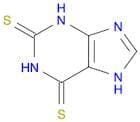
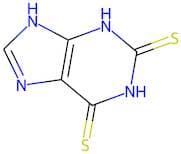
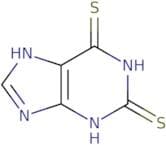
:3,9-Dihydro-1H-purine-2,6-dithione
Description:
3,9-Dihydro-1H-purine-2,6-dithione, with the CAS number 5437-25-2, is a heterocyclic compound that belongs to the purine family. This substance features a purine core structure, which is characterized by a fused double-ring system containing nitrogen atoms. The presence of two thioketone groups (dithione) at positions 2 and 6 of the purine ring contributes to its unique chemical properties, including potential reactivity and biological activity. The compound is typically a solid at room temperature and may exhibit solubility in polar solvents, depending on its specific structure and substituents. Its chemical behavior can be influenced by the presence of functional groups, making it of interest in various fields, including medicinal chemistry and biochemistry. The compound may also exhibit properties such as antioxidant activity or interactions with biological macromolecules, which could be relevant for research into therapeutic applications. However, detailed studies on its specific applications and biological effects are necessary to fully understand its potential uses.
Formula:C5H4N4S2
InChI:InChI=1S/C5H4N4S2/c10-4-2-3(7-1-6-2)8-5(11)9-4/h1H,(H3,6,7,8,9,10,11)
InChI key:InChIKey=VQPMXSMUUILNFZ-UHFFFAOYSA-N
SMILES:S=C1C2=C(NC(=S)N1)N=CN2
Synonyms:- 1H-Purine-2,6-dithione, 3,7-dihydro-
- 1H-Purine-2,6-dithione, 3,9-dihydro-
- 2,6-Dimercaptopurine
- 2,6-Dithioxanthine
- 2,6-Dithioxo-1,2,3,6-tetrahydro-9H-purine
- 3,5-dihydro-1H-purine-2,6-dithione
- 3,7-Dihydropurine-2,6-dithione
- 3,7-dihydro-1H-purine-2,6-dithione
- 3,9-Dihydro-1H-purine-2,6-dithione
- 6-thioxo-6,7-dihydro-3H-purine-2-thiolate
- Dithioxanthine
- NSC 15989
- NSC 685799
- Purine-2,6-dithiol
- See more synonyms
Sort by
Purity (%)
0
100
|
0
|
50
|
90
|
95
|
100
Found 4 products.
3,9-Dihydro-1H-purine-2,6-dithione
CAS:3,9-Dihydro-1H-purine-2,6-dithionePurity:97%Molecular weight:184.25g/mol2,6-Dimercaptopurine
CAS:2,6-Dimercaptopurine (2,6-DMP) is an immunosuppressive drug that is used to prevent organ transplants from being rejected. It blocks the synthesis of DNA and RNA in cells by inhibiting the enzyme thymidylate synthase. The reaction mechanism involves a nucleophilic attack on the phosphorus atom of 2,6-DMP by a proton from water or another nucleophile such as urea or ammonia. 2,6-DMP is metabolized through a number of tautomeric forms, which are neutral and acidic in pH. One example of this is when 2,6-DMP reacts with hydrochloric acid to form a conjugate base that can be excreted in urine.
Formula:C5H4N4S2Purity:Min. 95%Color and Shape:Yellow PowderMolecular weight:184.24 g/molRef: 3D-FD08201
Discontinued product