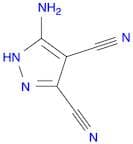
CAS 54385-49-8
:3-amino-1H-pyrazole-4,5-dicarbonitrile
Description:
3-Amino-1H-pyrazole-4,5-dicarbonitrile is a heterocyclic organic compound characterized by its pyrazole ring structure, which contains two cyano groups and an amino group. This compound is known for its potential applications in medicinal chemistry, particularly in the development of pharmaceuticals due to its ability to act as a building block for various bioactive molecules. The presence of the cyano groups contributes to its reactivity, allowing for further chemical modifications. It typically exhibits good solubility in polar organic solvents, which is advantageous for various synthetic processes. The compound's structure imparts certain biological activities, making it a subject of interest in research focused on anti-inflammatory and anticancer agents. Additionally, its stability under standard laboratory conditions makes it suitable for various synthetic applications. As with many nitrogen-containing heterocycles, it may also exhibit interesting electronic properties, which can be explored in materials science. Overall, 3-amino-1H-pyrazole-4,5-dicarbonitrile is a versatile compound with significant potential in both chemical synthesis and biological research.
Formula:C5H3N5
InChI:InChI=1/C5H3N5/c6-1-3-4(2-7)9-10-5(3)8/h(H3,8,9,10)
SMILES:C(#N)c1c(C#N)[nH][nH]c1=N
Sort by
Purity (%)
0
100
|
0
|
50
|
90
|
95
|
100
Found 3 products.
3-amino-1H-pyrazole-4,5-dicarbonitrile
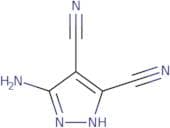
CAS:Formula:C5H3N5Purity:95%Color and Shape:SolidMolecular weight:133.11085-Amino-1H-pyrazole-3,4-dicarbonitrile
CAS:5-Amino-1H-pyrazole-3,4-dicarbonitrile is a nucleophilic compound that is used for the synthesis of other compounds. It reacts with anilines in the presence of silver ions and hydrogen chloride to form 5-aminopyrazoles. This reaction can also be reversed, forming pyrazoles from 5-aminopyrazoles. The product has been shown to have antimicrobial activity against methicillin resistant Staphylococcus aureus (MRSA), as well as being able to inhibit the growth of Mycobacterium tuberculosis and Mycobacterium avium complex. The product also has an effect on the central nervous system, producing sleepiness and sedation. These effects are due to its ability to inhibit brain monoamine oxidase (MAO) enzymes and block postsynaptic receptors in the central nervous system.Formula:C5H3N5Purity:Min. 95%Molecular weight:133.11 g/mol