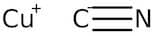
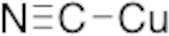
CAS 544-92-3
:Cuprous cyanide
- (cyano-kappaC)copper
- Cianuro De Cobre
- Copper cyanide
- Copper cyanide (Cu(CN))
- Copper monocyanide
- Copper(1+) Cyanide
- CopperIcyanide
- Cupricin
- Cuprous cyanide
- Cyanure de cuivre
- Kupfer(I)-Cyanid
- Kupfercyanid
- See more synonyms
Copper(I) Cyanide
CAS:Formula:CuCNPurity:>98.0%(T)Color and Shape:White to Dark green powder to crystalineMolecular weight:89.56Copper(I) cyanide
CAS:Copper(I) cyanide is commonly used as a polymerization catalyst. The compound is useful in organic synthesis, as a catalyst, reagent in the preparation of nitriles(sandmeyer reaction). It is also used in electroplating copper and iron, silver plating, brass plating, and copper-tin alloy plating. It
Formula:CCuNMolecular weight:89.56Copper(I) cyanide, 99%
CAS:Copper(I) cyanide, 99%
Formula:CuCNPurity:99%Color and Shape:off-white to pale green pwdr.Molecular weight:89.56Copper cyanide
CAS:Controlled ProductCopper cyanide is a compound that contains copper and cyanide ions. It can be used as a model system to study the reaction mechanism of the enzyme amino transferase. When copper cyanide is heated with hydrochloric acid, nitrogen gas, and water vapor, it produces ammonia, hydrogen cyanide and copper chloride. Copper cyanide has also been shown to inhibit the activity of other enzymes such as carbonic anhydrase, phosphofructokinase, and α-chymotrypsin. The reaction mechanism for this inhibition is still unclear.
Formula:CuCNPurity:Min. 95%Color and Shape:PowderMolecular weight:89.56 g/molCopper(I) Cyanide
CAS:Controlled ProductApplications Copper(I) cyanide is useful as a catalyst and as a reagent in the preparation of nitriles.
Not a dangerous good if item is equal to or less than 1g/ml and there is less than 100g/ml in the package
References Dieter, R.K., et al.: J. Org. Chem., 79, 1125 (2014);Formula:CCuNColor and Shape:NeatMolecular weight:89.56