CAS 5446-17-3
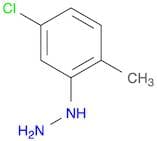
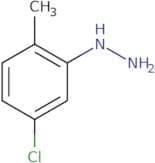
:(5-chloro-2-methylphenyl)hydrazine
Description:
(5-Chloro-2-methylphenyl)hydrazine is an organic compound characterized by its hydrazine functional group attached to a substituted aromatic ring. The presence of a chlorine atom at the 5-position and a methyl group at the 2-position of the phenyl ring contributes to its unique chemical properties. This compound typically appears as a colorless to pale yellow liquid or solid, depending on its state at room temperature. It is known for its reactivity, particularly in forming hydrazones and azo compounds, making it useful in various synthetic applications, including pharmaceuticals and agrochemicals. The compound may exhibit moderate toxicity, and appropriate safety measures should be taken when handling it, as it can be a potential irritant to skin and eyes. Additionally, it is important to consider its stability under different conditions, as hydrazine derivatives can be sensitive to heat and light. Overall, (5-chloro-2-methylphenyl)hydrazine is a valuable compound in organic synthesis, with specific applications driven by its chemical reactivity and structural characteristics.
Formula:C7H9ClN2
InChI:InChI=1/C7H9ClN2/c1-5-2-3-6(8)4-7(5)10-9/h2-4,10H,9H2,1H3
SMILES:Cc1ccc(cc1NN)Cl
Synonyms:- Hydrazine, (5-chloro-2-methylphenyl)-
- (5-Chloro-2-methylphenyl)hydrazine
Sort by
Purity (%)
0
100
|
0
|
50
|
90
|
95
|
100
Found 3 products.
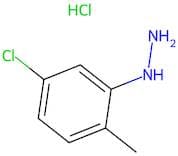
1-(5-Chloro-2-methylphenyl)hydrazine, HCl
CAS:Formula:C7H10Cl2N2Purity:97%Color and Shape:SolidMolecular weight:193.07375-Chloro-2-methylphenylhydrazine hydrochloride
CAS:5-Chloro-2-methylphenylhydrazine hydrochloridePurity:97%Molecular weight:193.07g/mol5-Chloro-2-methylphenylhydrazine hydrochloride
CAS:5-Chloro-2-methylphenylhydrazine hydrochloride (5CMPH) is an arylhydrazine that is used as a reagent in organic chemistry. It can be prepared from 2,6-dichloroacetamide and methyl phenyldiazonium chloride. 5CMPH has the molecular formula CHClN and a molecular weight of 182.8 g/mol. This compound is soluble in water and ethanol, but insoluble in ethers and benzene. 5CMPH has been shown to react with 6-membered heterocycles such as guanidinium chloride to form dialdehydes. When substituted at the 2 position with chlorine, it forms chlorinated arylhydrazines such as 6-chloro-N-(2-chlorophenyl)-2,4-dinitrobenzenamine, which have been shown to have antiinflammatory activities.Formula:C7H10Cl2N2Purity:Min. 95%Molecular weight:193.07 g/mol