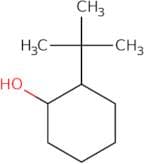
CAS 5448-22-6
:rel-(1R,2S)-2-(1,1-Dimethylethyl)cyclohexanol
Description:
Rel-(1R,2S)-2-(1,1-Dimethylethyl)cyclohexanol, with the CAS number 5448-22-6, is a chiral alcohol characterized by its cyclohexane ring structure substituted with a tert-butyl group at the second carbon position. This compound exhibits a specific stereochemistry, denoted by the (1R,2S) configuration, which influences its physical and chemical properties, including its reactivity and interactions with other molecules. Typically, cyclohexanol derivatives like this one are known for their moderate polarity due to the hydroxyl (-OH) group, which can engage in hydrogen bonding, affecting solubility in polar solvents. The presence of the bulky tert-butyl group contributes to steric hindrance, which can impact the compound's reactivity and conformational preferences. Additionally, such compounds are often utilized in organic synthesis and as intermediates in the production of various chemicals. Their unique structural features make them of interest in both academic research and industrial applications, particularly in the fields of pharmaceuticals and materials science.
Formula:C10H20O
InChI:InChI=1/C10H20O/c1-10(2,3)8-6-4-5-7-9(8)11/h8-9,11H,4-7H2,1-3H3/t8-,9-/s2
InChI key:InChIKey=DLTWBMHADAJAAZ-MDWBIBFBNA-N
SMILES:[C@](C)(C)(C)[C@H]1[C@H](O)CCCC1
Synonyms:- rel-(1R,2S)-2-(1,1-Dimethylethyl)cyclohexanol
- Cyclohexanol, 2-tert-butyl-, trans-
- Cyclohexanol, 2-(1,1-dimethylethyl)-, (1R,2S)-rel-
- trans-2-tert-Butylcyclohexanol
- Cyclohexanol, 2-(1,1-dimethylethyl)-, trans-
Sort by
Purity (%)
0
100
|
0
|
50
|
90
|
95
|
100
Found 1 products.
rac-(1R,2S)-2-tert-Butylcyclohexan-1-ol
CAS:Rac-1,2-cyclohexan-1,2-diol is a synthetic chemical that is used in the production of hydrogenated oils. It is produced by the hydrogenation of rac-dimethyl carbonate, which can be synthesized from cyclohexanol and tert-butyl chloride. Rac-1,2-cyclohexan-1,2-diol can be quantified using gas chromatography with a flame ionization detector (GC/FID) or high performance liquid chromatography (HPLC). The catalyst used for this reaction is typically a solid material such as platinum on carbon. The reaction requires anhydrous conditions and takes place at low temperatures. Racemic 1,2 cyclohexan-1,2 diol can also be produced through the dehydrogenation of racemic 2,3 cyclohexanedione with a palladium on charcoal catalyst. This process requires anhydrous conditions and takes place at high temperatures.Formula:C10H20OPurity:Min. 95%Molecular weight:156.26 g/mol