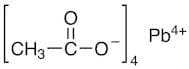
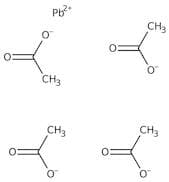
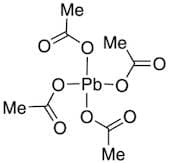
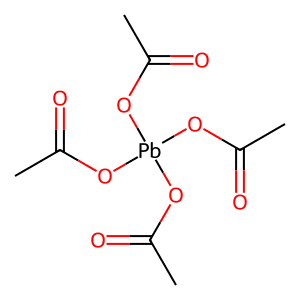
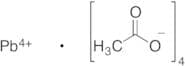
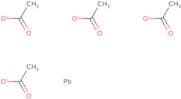
CAS 546-67-8
:Lead(IV) acetate
Description:
Lead(IV) acetate, also known as plumbic acetate, is a chemical compound with the formula Pb(C2H3O2)4. It is characterized by its lead(IV) oxidation state, which is less common than lead(II) compounds. This substance typically appears as a white crystalline solid and is soluble in water and organic solvents. Lead(IV) acetate is known for its use in organic synthesis, particularly as a reagent in the preparation of various organic compounds. It exhibits properties typical of lead compounds, including toxicity, and poses health risks upon exposure, necessitating careful handling and appropriate safety measures. The compound can decompose upon heating, releasing acetic acid and lead oxides. Due to its potential environmental and health hazards, the use of lead(IV) acetate is regulated in many jurisdictions, and alternatives are often sought in industrial applications. As with all lead-containing substances, it is crucial to manage its use responsibly to minimize exposure and environmental impact.
Formula:C8H12O8Pb
InChI:InChI=1/4C2H4O2.Pb/c4*1-2(3)4;/h4*1H3,(H,3,4);/q;;;;+2/p-4
InChI key:InChIKey=PNZVFASWDSMJER-UHFFFAOYSA-N
SMILES:C(C)(O)=O.[Pb]
Synonyms:- Acetate, Lead (Iv)
- Acetate, Lead(2+) Salt (4:1)
- Acetic acid, lead(4+) salt
- Acetic acid, lead(4+) salt (4:1)
- Bleitetraacetat
- LTA
- Lead (II) acetate
- Lead Tetracetate
- Lead acetate (Pb(O2C2H3)4)
- Lead acetate (Pb(O<sub>2</sub>C<sub>2</sub>H<sub>3</sub>)<sub>4</sub>)
- Lead acetate [Pb(OAc)4]
- Lead acetate [Pb(OAc)<sub>4</sub>]
- Lead tetraacetate
- Lead(4+) acetate
- Lead(IV) acetate (5-10% acetic acid)
- Lead(IV) tetraacetate
- Leadacetateaceticacidwhitetolightbrownxtl
- Plumbic acetate
- Tetraacetate de plomb
- Tetraacetato De Plomo
- Lead(IV)acetate
- leadacetate(pb(o2c2h3)4)
- LEAD ACETATE
- 4
- Tetrakis(acetyloxy)plumbane
- leadtetracetate
- Aceticacid,lead(4+)salt
- PB(ACAC)4
- plumbicacetate
- LEAD(IV) ACETATE GM
- tetra-leadacetat
- Pb(acac)
- leadacetate(pb(oac)4)
- See more synonyms
Sort by
Purity (%)
0
100
|
0
|
50
|
90
|
95
|
100
Found 9 products.
Lead Tetraacetate (contains Acetic Acid)
CAS:Formula:C8H12O8PbPurity:>96.0%(T)Color and Shape:White to Almost white powder to crystalMolecular weight:443.38Lead(IV) acetate, 96% (dry wt.), stab. with 5-10% glacial acetic acid
CAS:Lead(IV) acetate, 96% (dry wt.), stab. with 5-10% glacial acetic acid, Alfa AesarFormula:C8H12O8PbPurity:96%Color and Shape:Moist crystals or powder or crystalline powder, White to pale cream or pale greyMolecular weight:443.40Lead(IV) acetate, 95%
CAS:Lead(IV) acetate, 95%
Formula:Pb(OOCCH3)4Purity:95%Color and Shape:white to light brown xtl.Molecular weight:443.37Lead(IV) tetraacetate
CAS:Lead(IV) tetraacetateFormula:C8H12O8PbPurity:96%Color and Shape: very dark gray to black crystalline powderMolecular weight:443.37607g/molPlumbic acetate
CAS:Plumbic acetate releases acetate ions, acts as an oxidizer for sulfur (VI) synthesis, and reacts with thiodithiazyl dichloride.Formula:C2H4O2PbColor and Shape:SolidMolecular weight:267.3Lead(IV) Acetate, Stabilized
CAS:Controlled ProductStability Hygroscopic, Moisture Sensitive
Applications Lead(IV) acetate is most commonly used in synthetic chemistry as an oxidizing agent, and is a versatile precursor for lead-containing compounds. Lead(IV) acetate is a toxic substance to humans, and is also known to induce oxidative damage and hyperlipidemia in rats.
Not a dangerous good if item is equal to or less than 1g/ml and there is less than 100g/ml in the package
References Newairy, A., et al.: Food Chem. Toxicol., 47, 813 (2009); Rahman, S. & Sultana, S.: Chem.-Biol. Int., 160, 61 (2006); Yadav, R.: Synlett, 2012, 1262 (2012)Formula:C8H12O8PbColor and Shape:NeatMolecular weight:443.38Lead(IV) acetate - Stabilized with acetic acid (5-10%)
CAS:Lead acetate is an alkanoic acid that can be used as a lead salt. It has been shown to react with protocatechuic acid in the presence of hydrogen to form lead(IV) protocatechuate and acetic acid. This reaction mechanism can be applied to the analysis of other organic acids, such as fatty acids. Lead acetate also inhibits protease activity in vitro and has been shown to have therapeutic effects against autoimmune diseases and polycystic ovarian syndrome. Lead acetate has a low toxicity and is stable when mixed with trifluoroacetic acid or nitro compounds, but very reactive with strong oxidizing agents such as hydrochloric acid or hydrogen fluoride. Lead acetate is non-hygroscopic and insoluble in water, making it suitable for use in analytical chemistry.Formula:C8H12O8PbPurity:Min. 95%Color and Shape:White PowderMolecular weight:443.38 g/molLead tetraacetate; 5-10% of acetic acid
CAS:Formula:C8H12O8PbPurity:98%Color and Shape:SolidMolecular weight:443.3761