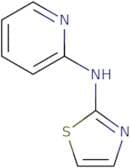
CAS 54670-80-3
:N-(1,3-thiazol-2-yl)pyridin-2-amine
Description:
N-(1,3-thiazol-2-yl)pyridin-2-amine, with the CAS number 54670-80-3, is a chemical compound characterized by its unique structural features, which include a pyridine ring and a thiazole moiety. This compound typically exhibits properties associated with heterocyclic compounds, such as moderate solubility in polar solvents and potential biological activity due to its ability to interact with various biological targets. The presence of both nitrogen and sulfur atoms in its structure contributes to its reactivity and potential as a ligand in coordination chemistry. Additionally, compounds like this one are often investigated for their pharmacological properties, including antimicrobial and anticancer activities. Its synthesis usually involves multi-step organic reactions, and it may serve as an intermediate in the development of more complex pharmaceuticals. Overall, N-(1,3-thiazol-2-yl)pyridin-2-amine is of interest in both synthetic organic chemistry and medicinal chemistry due to its diverse applications and biological significance.
Formula:C8H7N3S
InChI:InChI=1/C8H7N3S/c1-2-4-9-7(3-1)11-8-10-5-6-12-8/h1-6H,(H,9,10,11)
SMILES:c1ccnc(c1)Nc1nccs1
Synonyms:- 54670-80-3
Sort by
Purity (%)
0
100
|
0
|
50
|
90
|
95
|
100
Found 1 products.
N-(1,3-Thiazol-2-yl)pyridin-2-amine
CAS:<p>N-(1,3-Thiazol-2-yl)pyridin-2-amine is a tyrosine kinase inhibitor that can be used to treat cancer. It was found to inhibit the growth of tumor cells by interfering with their ability to make new proteins. The drug also has a low molecular weight and a high solubility in water, which makes it suitable for intravenous administration. N-(1,3-Thiazol-2-yl)pyridin-2-amine inhibits protein kinases through competitive binding to the ATP binding site on the enzyme's active site. It has an analog profile that includes low molecular weight and high solubility in water, making it suitable for intravenous administration. Additionally, it has been shown that this drug is selective for receptor tyrosine kinases over other types of protein kinases (e.g., serine/threonine), while still exhibiting cross covalent coupling with piperazine</p>Formula:C8H7N3SPurity:Min. 95%Molecular weight:177.23 g/mol