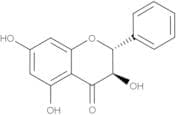
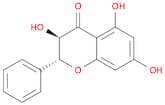
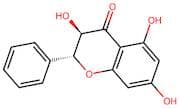
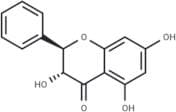
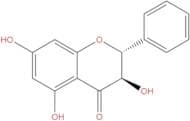
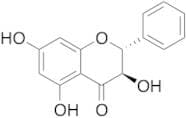
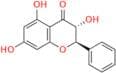
CAS 548-82-3
:Pinobanksin
Description:
Pinobanksin, with the CAS number 548-82-3, is a naturally occurring flavonoid compound primarily found in various plants, particularly in the resin of certain species of pine. It is classified as a flavanone, which is a type of flavonoid characterized by a specific chemical structure that includes a chromone backbone. Pinobanksin exhibits antioxidant properties, which contribute to its potential health benefits, including anti-inflammatory and antimicrobial effects. The compound is often studied for its role in traditional medicine and its potential applications in food preservation and cosmetics due to its ability to scavenge free radicals. In terms of physical properties, pinobanksin is typically a yellowish crystalline solid, and it is soluble in organic solvents but has limited solubility in water. Its chemical structure allows for various derivatives, which can enhance its biological activity. Overall, pinobanksin is of interest in both pharmacological research and natural product chemistry due to its diverse biological activities and potential therapeutic applications.
Formula:C15H12O5
InChI:InChI=1S/C15H12O5/c16-9-6-10(17)12-11(7-9)20-15(14(19)13(12)18)8-4-2-1-3-5-8/h1-7,14-17,19H/t14-,15+/m0/s1
InChI key:InChIKey=SUYJZKRQHBQNCA-LSDHHAIUSA-N
SMILES:O=C1C=2C(O[C@@H]([C@H]1O)C3=CC=CC=C3)=CC(O)=CC2O
Synonyms:- (2R,3R)-2,3-Dihydro-3,5,7-trihydroxy-2-phenyl-4H-1-benzopyran-4-one
- (2R,3R)-Pinobanksin
- 3,5,7-Trihydroxyflavanone
- 4H-1-Benzopyran-4-one, 2,3-dihydro-3,5,7-trihydroxy-2-phenyl-, (2R-trans)-
- 4H-1-benzopyran-4-one, 2,3-dihydro-3,5,7-trihydroxy-2-phenyl-, (2R,3R)-
- Dihydrogalangin
- Flavanone, 3,5,7-trihydroxy-
- Pinobanksin
Sort by
Purity (%)
0
100
|
0
|
50
|
90
|
95
|
100
Found 10 products.
Pinobanksin
CAS:Pinobanksin analytical standard provided with chromatographic purity, to be used as reference material for qualitative determination.Formula:C15H12O5Purity:(HPLC) ≥95%Color and Shape:PowderMolecular weight:272.26(2R,3R)-2,3-Dihydro-3,5,7-trihydroxy-2-phenyl-4H-1-benzopyran-4-one
CAS:Formula:C15H12O5Purity:%Color and Shape:SolidMolecular weight:272.2528Pinobanksin
CAS:Pinobanksin is a natural flavonoid that induces apoptosis in cancer cells. It is a potent antioxidant that inhibits the peroxidation of LDL and inhibits XO.Formula:C15H12O5Purity:99.92%Color and Shape:SolidMolecular weight:272.25Pinobanksin
CAS:Applications Pinobanksin is a dihydroflavonol that posesses antioxidant properties. Pinobanksin is most commonly found in propolis, a material utilized by bees in the construction of their hives.
References Burdock, G.: Food Chem. Toxicol., 36, 347 (1998); Loman, A.: Bulletin, 13, no pp given (1970); Neacsu, M., et al.: Holz Roh. Werks., 65, 1 (2007)Formula:C15H12O5Color and Shape:NeatMolecular weight:272.25rac-Pinobanksin
CAS:Rac-Pinobanksin is a flavonoid that has been shown to have antioxidant and anti-inflammatory properties. It is extracted from propolis and has been shown to stimulate the mitochondrial membrane potential in colorectal adenocarcinoma cells and increase energy metabolism. Rac-Pinobanksin also inhibits the activity of p-hydroxybenzoic acid (PHBA) hydroxylase, which metabolizes PHBA into p-hydroxybenzoic acid (PHBA). Rac-Pinobanksin acetate has also been shown to inhibit the activity of the enzyme caffeoyl esterase, which catalyzes the hydrolysis of caffeic acids (CA) into ferulic acid (FA) and p-coumaric acid (PCA). Rac-Pinobanksin acetate increases FA levels and decreases PCA levels.Formula:C15H12O5Purity:Min. 95%Molecular weight:272.25 g/mol