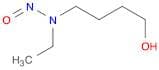
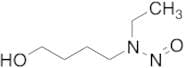
CAS 54897-62-0
:4-(Ethylnitrosoamino)-1-butanol
Description:
4-(Ethylnitrosoamino)-1-butanol, with the CAS number 54897-62-0, is a chemical compound that belongs to the class of nitrosoamines, which are known for their potential carcinogenic properties. This compound features a butanol backbone with an ethylnitrosoamino group, which contributes to its reactivity and biological activity. Typically, nitrosoamines are formed through the reaction of nitrous acid with secondary amines, and they can be found in various environments, including food products and tobacco smoke. The presence of the nitroso group (-N=O) is significant, as it can participate in various chemical reactions, including alkylation and nitrosation processes. The compound's solubility, stability, and reactivity can be influenced by factors such as pH and temperature. Due to its potential health risks, particularly in relation to cancer, compounds like 4-(Ethylnitrosoamino)-1-butanol are of interest in toxicology and public health research. Proper handling and safety measures are essential when working with such substances in laboratory or industrial settings.
Formula:C6H14N2O2
InChI:InChI=1/C6H14N2O2/c1-2-8(7-10)5-3-4-6-9/h9H,2-6H2,1H3
InChI key:InChIKey=SAWPRHGGVOPPSR-UHFFFAOYSA-N
SMILES:N(CCCCO)(CC)N=O
Synonyms:- 1-Butanol, 4-(ethylnitrosoamino)-
- 4-(Ethylnitrosoamino)-1-butanol
- 4-(N-Ethyl-N-nitrosoamino)-1-butanol
- 4-[Ethyl(Nitroso)Amino]Butan-1-Ol
- N-Ethyl-N-(4-hydroxybutyl)nitrosamine
- N-Ethyl-N-(4-hydroxybutyl)nitrosoamine
- N-Ethyl-N-butan-4-ol-nitrosamine
- N-ethyl-(4-hydroxybutyl)nitrosamine
- -Ethyl-
- ethylbutanolnitrosamine
- 4-(ethylnitrosoamino)-1-butano
- N-ETHYL-N-NITROSO-4-AMINOBUTANOL
- N
- N-Ethyl-N-nitroso-4-aminobutanol
- ehbn
- See more synonyms
Sort by
Purity (%)
0
100
|
0
|
50
|
90
|
95
|
100
Found 2 products.
N-ethyl-n-butan-4-ol-nitrosamine
CAS:Formula:C6H14N2O2Purity:95%Color and Shape:LiquidMolecular weight:146.1876N-Ethyl-N-butan-4-ol-nitrosamine
CAS:Controlled ProductApplications N-Ethyl-N-butan-4-ol-nitrosamine can be used to study lack of tumorigenic effects on rat renal pelvic transitional epithelium of life-span exposure to low doses of a bladder carcinogen
References Shibata, M.A., et.al.: J. Toxicol. Pathol., 6, 47-53, (1993);Formula:C6H14N2O2Color and Shape:Colourless To Light YellowMolecular weight:146.19