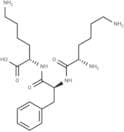
CAS 54925-87-0
:2-(2-amino-3-phenylpropanoyl)-3-(2,6-diaminohexanoyl)lysine
Description:
2-(2-amino-3-phenylpropanoyl)-3-(2,6-diaminohexanoyl)lysine, with the CAS number 54925-87-0, is a synthetic compound that belongs to the class of amino acids and peptides. This substance features a complex structure characterized by multiple functional groups, including amino and carboxyl groups, which contribute to its properties as a potential bioactive molecule. The presence of phenyl and hexanoyl side chains suggests that it may exhibit hydrophobic characteristics, influencing its solubility and interaction with biological membranes. The compound's structure indicates that it could participate in various biochemical processes, possibly acting as a substrate or inhibitor in enzymatic reactions. Additionally, the presence of multiple amino groups may enhance its ability to form hydrogen bonds, affecting its stability and reactivity. Overall, this compound's unique structural features may make it of interest in pharmaceutical research, particularly in the development of therapeutic agents targeting specific biological pathways.
Formula:C21H35N5O4
InChI:InChI=1/C21H35N5O4/c22-11-5-4-10-16(24)18(27)15(9-6-12-23)21(26,20(29)30)19(28)17(25)13-14-7-2-1-3-8-14/h1-3,7-8,15-17H,4-6,9-13,22-26H2,(H,29,30)
SMILES:c1ccc(cc1)CC(C(=O)C(C(CCCN)C(=O)C(CCCCN)N)(C(=O)O)N)N
Synonyms:- Lysyl-Phenylalanyl-Lysine
Sort by
Purity (%)
0
100
|
0
|
50
|
90
|
95
|
100
Found 3 products.
Lysyl-phenylalanyl-lysine
CAS:Lysyl-phenylalanyl-lysine is a bioactive chemical.Formula:C21H35N5O4Color and Shape:SolidMolecular weight:421.53L-Lysyl-L-phenylalanyl-L-lysine trifluoroacetate
CAS:Please enquire for more information about L-Lysyl-L-phenylalanyl-L-lysine trifluoroacetate including the price, delivery time and more detailed product information at the technical inquiry form on this page
Formula:C21H35N5O4•(C2HF3O2)xPurity:Min. 95%Color and Shape:PowderH-Lys-Phe-Lys-OH acetate salt
CAS:H-Lys-Phe-Lys-OH acetate salt is a dinucleotide that contains two molecules of the amino acids lysine and phenylalanine. The H-Lys-Phe-Lys-OH acetate salt interacts with the monoclonal antibody, which then binds to the tumor cells. This interaction can be measured by an oscilloscope and is used for molecular imaging. The constant value is determined by optimizing the concentration of tripeptides and tetrapeptides in order to produce a fluorescent signal from the fatty acids. The glycosidic bond between the H-Lys-Phe-Lys molecule and its acetate salt allows for fluorescence, which can be measured by a monoclonal antibody.Formula:C21H35N5O4Purity:Min. 95%Molecular weight:421.53 g/mol