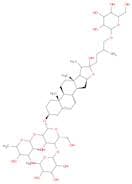
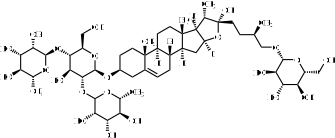
CAS 55056-80-9
:Protodioscin
Description:
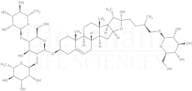
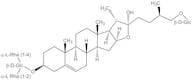
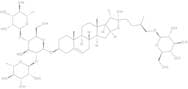
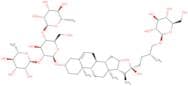
Protodioscin is a naturally occurring steroidal saponin primarily found in various plant species, particularly in the genus Dioscorea, commonly known as yam. It is recognized for its potential pharmacological properties, including its role as an adaptogen and its ability to enhance physical performance and libido. Structurally, protodioscin consists of a steroid backbone with a sugar moiety, which contributes to its biological activity. The compound is often studied for its effects on hormone levels, particularly testosterone, and its potential use in traditional medicine for improving sexual health and vitality. Additionally, protodioscin exhibits antioxidant and anti-inflammatory properties, making it a subject of interest in the field of natural product research. Its safety profile and efficacy are still under investigation, and while it is generally considered safe in moderate amounts, further studies are needed to fully understand its therapeutic potential and mechanisms of action. As with any bioactive compound, it is essential to approach its use with caution and under appropriate guidance.
Formula:C51H84O22
InChI:InChI=1S/C51H84O22/c1-20(19-65-45-39(60)38(59)35(56)30(17-52)69-45)9-14-51(64)21(2)32-29(73-51)16-28-26-8-7-24-15-25(10-12-49(24,5)27(26)11-13-50(28,32)6)68-48-44(72-47-41(62)37(58)34(55)23(4)67-47)42(63)43(31(18-53)70-48)71-46-40(61)36(57)33(54)22(3)66-46/h7,20-23,25-48,52-64H,8-19H2,1-6H3/t20-,21+,22+,23+,25+,26-,27+,28+,29+,30-,31-,32+,33+,34+,35-,36-,37-,38+,39-,40-,41-,42+,43-,44-,45-,46+,47+,48-,49+,50+,51-/m1/s1
InChI key:InChIKey=LVTJOONKWUXEFR-UEZXSUPNSA-N
SMILES:C[C@@]12[C@]([C@]3([C@](CC1)([C@]4(C)C(=CC3)C[C@@H](O[C@H]5[C@H](O[C@H]6[C@H](O)[C@H](O)[C@@H](O)[C@H](C)O6)[C@@H](O)[C@H](O[C@H]7[C@H](O)[C@H](O)[C@@H](O)[C@H](C)O7)[C@@H](CO)O5)CC4)[H])[H])(C[C@]8([C@@]2([C@H](C)[C@](CC[C@H](CO[C@@H]9O[C@H](CO)[C@@H](O)[C@H](O)[C@H]9O)C)(O)O8)[H])[H])[H]
Synonyms:- (3beta,22R,25R)-26-(beta-D-glucopyranosyloxy)-22-hydroxyfurost-5-en-3-yl 6-deoxy-alpha-L-mannopyranosyl-(1->2)-[6-deoxy-alpha-L-mannopyranosyl-(1->4)]-beta-D-glucopyranoside
- (3β,22α,25R)-26-(β-<span class="text-smallcaps">D</smallcap>-Glucopyranosyloxy)-22-hydroxyfurost-5-en-3-yl O-6-deoxy-α-<smallcap>L</smallcap>-mannopyranosyl-(1→2)-O-[6-deoxy-α-<smallcap>L</smallcap>-mannopyranosyl-(1→4)]-β-<smallcap>D</span>-glucopyranoside
- 26-O-beta-D-Glycopyranosyl-22-hydroxyfurost-5-ene-3beta,26-diol-3-O-beta-diglucorhamnoside
- 26-O-β-<span class="text-smallcaps">D</smallcap>-Glucopyranosyl-(25R)-furost-5-ene-3β,22α,26-triol 3-O-α-<smallcap>L</smallcap>-rhamnopyranosyl-(1-2)-[α-<smallcap>L</smallcap>-rhamnopyranosyl-(1-4)]-β-<smallcap>D</span>-glucopyranoside
- 3β,22α,26-Trihydroxyfurost-5-ene 3-O-β-chacotrioside 26-O-β-<span class="text-smallcaps">D</span>-glucopyranoside
- β-<span class="text-smallcaps">D</smallcap>-Glucopyranoside, (3β,22α,25R)-26-(β-<smallcap>D</smallcap>-glucopyranosyloxy)-22-hydroxyfurost-5-en-3-yl O-6-deoxy-α-<smallcap>L</smallcap>-mannopyranosyl-(1→2)-O-[6-deoxy-α-<smallcap>L</span>-mannopyranosyl-(1→4)]-
- 26-O-β-D-Glucopyranosyl-(25R)-furost-5-ene-3β,22α,26-triol 3-O-α-L-rhamnopyranosyl-(1-2)-[α-L-rhamnopyranosyl-(1-4)]-β-D-glucopyranoside
- 3β,22α,26-Trihydroxyfurost-5-ene 3-O-β-chacotrioside 26-O-β-D-glucopyranoside
- β-D-Glucopyranoside, (3β,22α,25R)-26-(β-D-glucopyranosyloxy)-22-hydroxyfurost-5-en-3-yl O-6-deoxy-α-L-mannopyranosyl-(1→2)-O-[6-deoxy-α-L-mannopyranosyl-(1→4)]-
- (3β,22α,25R)-26-(β-D-Glucopyranosyloxy)-22-hydroxyfurost-5-en-3-yl O-6-deoxy-α-L-mannopyranosyl-(1→2)-O-[6-deoxy-α-L-mannopyranosyl-(1→4)]-β-D-glucopyranoside
- Protodioscin
Sort by
Purity (%)
0
100
|
0
|
50
|
90
|
95
|
100
Found 9 products.
Protodioscin
CAS:Protodioscin has been shown to exhibit multiple biological actions, such as anti-hyperlipidemia, anti-cancer, sexual effects and cardiovascular properties. It appears to possess aphrodisiac activity probably due to its androgen increasing property, it will be useful in developing health food supplement(s) and/or drug(s) against hyperlipidemia.Formula:C51H84O22Purity:95%~99%Molecular weight:1049.21Protodioscin
CAS:Protodioscin (Furostanol I) is a major steroidal saponin in dioscoreae rhizome, with anti-hyperlipidemia, anti-cancer properties.Formula:C51H84O22Purity:98% - 99.66%Color and Shape:Brown Yellow PowderMolecular weight:1049.20Ref: TM-T2321
2mg34.00€5mg52.00€10mg71.00€1mL*10mM (DMSO)80.00€25mg114.00€50mg167.00€100mg240.00€200mg355.00€Protodioscin
CAS:Natural glycosideFormula:C51H84O22Purity:≥ 90.0 % (HPLC)Color and Shape:PowderMolecular weight:1049.22Protodioscin
CAS:Applications Protodioscin is a steroidal saponin compound found in a number of plant species. It is known to be the active component of the herbal aphrodisiac plant Tribulus terrestris. It has also shown to produce significant increases in the levels of the hormonal levels in animal studies.
References Gauthaman, K., et al.: Inter. J. Phytother. Phytopharm., 15, 44 (2008); Ganzera, M., et al.: J. Pharmac. Sci., 90(11), 1752 (2001);Formula:C51H84O22Color and Shape:Off-White To Light BeigeMolecular weight:1049.2Protodioscin
CAS:Protodioscin is a steroidal saponin, which is a naturally occurring glycoside. It is predominantly sourced from the plant Tribulus terrestris but can also be found in other medicinal plants such as Dioscorea species. The mode of action of protodioscin involves its ability to influence the levels of dehydroepiandrosterone (DHEA) and other hormones, potentially affecting physiological functions related to vitality and performance.Formula:C51H84O22Purity:Min. 95%Color and Shape:PowderMolecular weight:1,049.22 g/mol