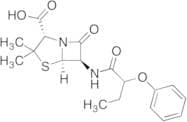
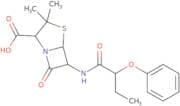
CAS 551-27-9
:Propicillin
- (1-Phenoxypropyl)Penicillin
- (2S,5R,6R)-3,3-Dimethyl-7-oxo-6-[(1-oxo-2-phenoxybutyl)amino]-4-thia-1-azabicyclo[3.2.0]heptane-2-carboxylic acid
- (2S,5R,6R)-3,3-dimethyl-7-oxo-6-[(2-phenoxybutanoyl)amino]-4-thia-1-azabicyclo[3.2.0]heptane-2-carboxylic acid
- 3,3-Dimethyl-7-Oxo-6-[(2-Phenoxybutanoyl)Amino]-4-Thia-1-Azabicyclo[3.2.0]Heptane-2-Carboxylic Acid
- 3,3-Dimethyl-7-oxo-6-(2-phenoxybutyramido)-4-thia-1-azabicyclo[3.2.0]heptane-2-carboxylic acid
- 4-Thia-1-azabicyclo[3.2.0]heptane-2-carboxylic acid, 3,3-dimethyl-7-oxo-6-(2-phenoxybutyramido)-
- 4-Thia-1-azabicyclo[3.2.0]heptane-2-carboxylic acid, 3,3-dimethyl-7-oxo-6-[(1-oxo-2-phenoxybutyl)amino]-, (2S,5R,6R)-
- 4-Thia-1-azabicyclo[3.2.0]heptane-2-carboxylic acid, 3,3-dimethyl-7-oxo-6-[(1-oxo-2-phenoxybutyl)amino]-, [2S-(2α,5α,6β)]-
- Penicillin, (1-phenoxypropyl)-
- Phenoxypropylpenicillin
- Synthepen P
- α-Phenoxybutyryl-6-aminopenicillanic acid
- See more synonyms
Propicillin
CAS:Controlled ProductApplications Propicillin, is a derivative of penicillin. Properties are similar to benzylpenicillin particularly used in streptococcal infections, not resistant to penicillinase.
References Fleming, A., et al.: Br. J. Exp. Pathol., 10, 226 (1929), Clutterbuck, P.W., et al.: Biochem. J., et al.: 26, 1907 (1932), Chain, E., et al.: Lancet, 2, 226 (1940),Formula:C18H22N2O5SColor and Shape:NeatMolecular weight:378.443Propicillin
CAS:Propicillin is a broad-spectrum antimicrobial agent that has been shown to be effective against both gram-positive and gram-negative bacteria. Propicillin belongs to the group of nonsteroidal anti-inflammatory drugs. It is a particle that is soluble in water and lipid. Propicillin does not inhibit the growth of Streptococcus species, but does cause cell lysis by attaching to fatty acids on the surface of cells. Propicillin also inhibits microbial infection by inhibiting enzymes involved in fatty acid synthesis. The human serum pharmacokinetics of propicillin have been studied and found to be similar to those of ampicillin, which allows for use as an intravenous drug in humans. The pharmacokinetics, biochemical properties, and cellular mechanisms are complex, but it is known that propicillin binds to bacterial ribosomes and inhibits protein synthesis by binding to the peptidyl transferase centre on the ribosome.
Formula:C18H22N2O5SPurity:Min. 95%Molecular weight:378.4 g/mol