CAS 55171-60-3
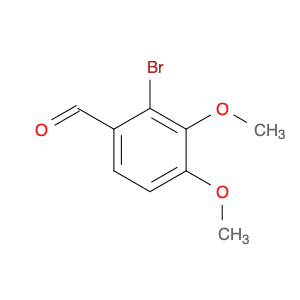
:2-BROMO-3,4-DIMETHOXYBENZALDEHYDE
Description:
2-Bromo-3,4-dimethoxybenzaldehyde is an organic compound characterized by its aromatic structure, which includes a bromine atom and two methoxy groups attached to a benzaldehyde moiety. The presence of the bromine atom enhances its reactivity, making it useful in various synthetic applications, particularly in organic synthesis and medicinal chemistry. The methoxy groups contribute to the compound's electron-donating properties, influencing its reactivity and solubility in organic solvents. This compound typically appears as a solid at room temperature and is soluble in organic solvents such as ethanol and dichloromethane. Its aldehyde functional group is reactive, allowing for further transformations, such as condensation reactions. 2-Bromo-3,4-dimethoxybenzaldehyde is often utilized as an intermediate in the synthesis of more complex organic molecules, including pharmaceuticals and agrochemicals. Safety precautions should be observed when handling this compound, as it may pose health risks if inhaled or ingested.
Sort by
Purity (%)
0
100
|
0
|
50
|
90
|
95
|
100
Found 6 products.
2-Bromo-3,4-dimethoxybenzaldehyde
CAS:Formula:C9H9BrO3Purity:98%Color and Shape:SolidMolecular weight:245.07002-Bromo-3,4-dimethoxybenzaldehyde
CAS:2-Bromo-3,4-dimethoxybenzaldehydePurity:98%Molecular weight:245.07g/mol2-Bromoveratraldehyde
CAS:Controlled ProductApplications Meconin (M202900) intermediate.
Formula:C9H9BrO3Color and Shape:NeatMolecular weight:245.072-Bromo-3,4-dimethoxybenzaldehyde
CAS:Formula:C9H9BrO3Purity:98%Color and Shape:SolidMolecular weight:245.0722-Bromo-3,4-dimethoxybenzaldehyde
CAS:2-Bromo-3,4-dimethoxybenzaldehyde (BDMB) is a fluorescent aldehyde that can be used as an analog for 2,4-dinitrofluorobenzene. It has been shown to have cytotoxic effects on cancer cells. BDMB binds to microtubules and inhibits their polymerization and depolymerization, preventing the formation of the cytoskeleton in the cell. This leads to cell death by apoptosis. The affinity of BDMB for microtubules is much higher than its affinity for other cellular components. BDMB also has been shown to inhibit DNA synthesis in cancer cells through inhibition of RNA polymerase II transcription.Formula:C9H9BrO3Purity:Min. 95%Molecular weight:245.07 g/mol