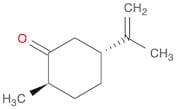
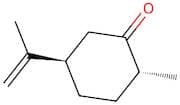
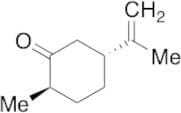
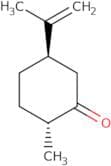
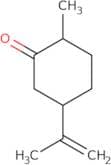
CAS 5524-05-0
:(+)-Dihydrocarvone
Description:
(+)-Dihydrocarvone is a chiral monoterpenoid ketone, primarily known for its minty aroma, which makes it a valuable compound in the flavor and fragrance industry. It is a colorless to pale yellow liquid at room temperature and is characterized by its pleasant, mint-like scent. The compound has a molecular formula of C10H16O and features a cyclohexene ring with a carbonyl group, contributing to its reactivity and potential applications in organic synthesis. (+)-Dihydrocarvone is soluble in organic solvents such as ethanol and ether but has limited solubility in water. Its optical activity is notable, as it exists in two enantiomeric forms, with the (+) form being the naturally occurring variant. This compound is often used in the formulation of perfumes, cosmetics, and food products, and it may also exhibit biological activities, including antimicrobial properties. Safety data indicates that it should be handled with care, as it can cause irritation upon contact with skin or eyes.
Formula:C10H16O
InChI:InChI=1S/C10H16O/c1-7(2)9-5-4-8(3)10(11)6-9/h8-9H,1,4-6H2,2-3H3/t8-,9-/m1/s1
InChI key:InChIKey=AZOCECCLWFDTAP-RKDXNWHRSA-N
SMILES:C(C)(=C)[C@H]1CC(=O)[C@H](C)CC1
Synonyms:- (+)-Dihydrocarvone, mixture of isomers
- (+)-trans-Dihydrocarvone
- (1R,4R)-(+)-Dihydrocarvone
- (2R,5R)-(+)-Dihydrocarvone
- (2R,5R)-2-Methyl-5-(1-methylethenyl)cyclohexanone
- (2R,5R)-2-Methyl-5-(prop-1-en-2-yl)cyclohexan-1-one
- (2R,5R)-2-methyl-5-(prop-1-en-2-yl)cyclohexanone
- (2R,5R)-5-Isopropenyl-2-methylcyclohexanone
- (2S,5R)-2-methyl-5-(prop-1-en-2-yl)cyclohexanone
- 8-p-Menthen-2-one
- Cyclohexanone, 2-methyl-5-(1-methylethenyl)-, (2R,5R)-
- Cyclohexanone, 2-methyl-5-(1-methylethenyl)-, (2R-trans)-
- d-Dihydrocarvone
- p-Menth-8(9)-en-2-one
- p-Menth-8-en-2-one, (+)-
- (+)-Dihydrocarvone
- Cyclohexanone,2-methyl-5-(1-methylethenyl)-,trans-
- p-Menth-8-en-2-one,trans-
- (2R-trans)-2-methyl-5-(1-methylvinyl)cyclohexan-1-one
- (+)-dihydrocarvone,mixtureofisomers
- (2R)-2α-Methyl-5β-(1-methylethenyl)cyclohexanone
- Cyclohexanone,2-methyl-5-(1-methylethenyl)-,(2R,5R)-rel-
- DIHYDROCARVONE/2-METHYL-5-(1-METHYLETHENYL)-,(2R-TRANS)-CYCLOHEXANONE
- (2R)-2α-Methyl-5β-isopropenylcyclohexanone
- (2theta-trans)-cyclohexanon
- 2-methyl-5-(1-methylethenyl)-,(2R-trans)-Cyclohexanone
- (2R,5R)-2-Methyl-5-isopropenylcyclohexanone
- See more synonyms
Sort by
Purity (%)
0
100
|
0
|
50
|
90
|
95
|
100
Found 7 products.
(+)-DIHYDROCARVONE MIXTURE OF ISOMERS
CAS:Formula:C10H16OPurity:98%Color and Shape:LiquidMolecular weight:152.2334(2R,5R)-2-Methyl-5-(Prop-1-En-2-Yl)Cyclohexanone
CAS:(2R,5R)-2-Methyl-5-(Prop-1-En-2-Yl)CyclohexanonePurity:98%, stabilized with TBCMolecular weight:152.23g/mol(+)-Dihydrocarvone (Mixture of (2S)/(2R) isomers)
CAS:Formula:C10H16OColor and Shape:NeatMolecular weight:152.23D-Dihydrocarvone
CAS:D-Dihydrocarvone is a compound that has shown promising effects in the treatment of epileptic encephalopathy. It has been found to interact with the 5-HT2C receptor, which plays a role in regulating serotonin levels in the brain. This interaction may contribute to its antiepileptic properties. Additionally, D-Dihydrocarvone has been studied for its potential cardiovascular benefits. It has been shown to have myocardial protective effects and may help improve cardiac function in certain conditions. Furthermore, D-Dihydrocarvone has demonstrated sodium-dependent glucose transporter inhibitory activity, suggesting potential applications in managing diabetes. Overall, this compound holds promise for various therapeutic applications and warrants further research.Formula:C10H16OPurity:Min. 97 Area-%Molecular weight:152.23 g/mol(2R,5R)-2-Methyl-5-(prop-1-en-2-yl)cyclohexanone
CAS:Formula:C10H16OPurity:95%Color and Shape:LiquidMolecular weight:152.237(2R,5R)-2-Methyl-5-(prop-1-en-2-yl)cyclohexan-1-one
CAS:(2R,5R)-2-Methyl-5-(prop-1-en-2-yl)cyclohexan-1-one is an enantiomer of (2S,5S)-2-methyl-5-(prop-1-en-2-yl)cyclohexan -1 -one. It belongs to the class of saponins and has been shown to have a synergistic effect with glutamic acid in the synthesis of deionized water. It can be used as a test drug for the detection of staphylococcus bacteria.Formula:C10H16OPurity:Min. 95%Molecular weight:152.23 g/mol