CAS 55306-66-6
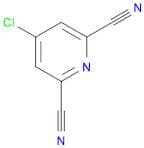
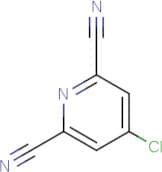
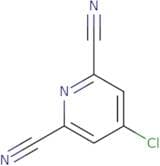
:4-Chloro-2,6-pyridinedicarbonitrile
Description:
4-Chloro-2,6-pyridinedicarbonitrile is a heterocyclic organic compound characterized by its pyridine ring structure, which is substituted with two cyano groups and a chlorine atom. The presence of the cyano groups (-C≡N) contributes to its polarity and potential reactivity, making it useful in various chemical syntheses and applications. The chlorine atom introduces additional reactivity and can influence the compound's solubility and interaction with other molecules. This compound is typically a solid at room temperature and may exhibit moderate to high stability under standard conditions. Its applications can range from serving as an intermediate in the synthesis of pharmaceuticals to being utilized in agrochemicals. The compound's unique structure allows for potential interactions in biological systems, which may be of interest in medicinal chemistry. Safety data should be consulted for handling, as compounds with cyano groups can be toxic and require appropriate precautions.
Sort by
Purity (%)
0
100
|
0
|
50
|
90
|
95
|
100
Found 4 products.
4-Chloro-2,6-pyridinedicarbonitrile
CAS:Formula:C7H2ClN3Purity:97%Color and Shape:SolidMolecular weight:163.56394-Chloropyridine-2,6-dicarbonitrile
CAS:4-Chloropyridine-2,6-dicarbonitrilePurity:95%Color and Shape:SolidMolecular weight:163.56g/mol4-Chloropyridine-2,6-dicarbonitrile
CAS:Formula:C7H2ClN3Purity:95.0%Color and Shape:SolidMolecular weight:163.564-Chloropyridine-2,6-dicarbonitrile
CAS:4-Chloropyridine-2,6-dicarbonitrile (4CP) is a ruthenium(II) complex that has been used in solar cells because of its high efficiency. It has been shown to be an efficient acceptor for singlet excitation and has a long fluorescence lifetime. 4CP is also able to generate electron transfer from the excited state to the ground state, leading to increased efficiencies in solar cells. 4CP is a pyridine compound that can be synthesized by reacting benzene with pyridine in the presence of activated charcoal at 400 °C.Formula:C7H2ClN3Purity:Min. 95%Molecular weight:163.56 g/mol