CAS 55586-68-0
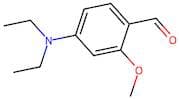
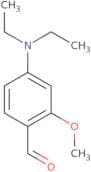
:4-(diethylamino)-2-methoxybenzaldehyde
Description:
4-(Diethylamino)-2-methoxybenzaldehyde, with the CAS number 55586-68-0, is an organic compound characterized by its aromatic structure, which includes a methoxy group and a diethylamino group attached to a benzaldehyde moiety. This compound typically appears as a yellow to orange solid or liquid, depending on its purity and specific conditions. It is known for its role as a dye intermediate and in various organic synthesis applications. The presence of the diethylamino group imparts basic properties, allowing it to participate in various chemical reactions, including nucleophilic substitutions and electrophilic aromatic substitutions. Additionally, the methoxy group can influence the compound's reactivity and solubility in organic solvents. Its unique structure contributes to its potential applications in the fields of pharmaceuticals, dyes, and materials science. Safety data should be consulted for handling, as it may pose health risks if inhaled or ingested, and appropriate precautions should be taken during its use in laboratory settings.
Formula:C12H17NO2
InChI:InChI=1/C12H17NO2/c1-4-13(5-2)11-7-6-10(9-14)12(8-11)15-3/h6-9H,4-5H2,1-3H3
SMILES:CCN(CC)c1ccc(C=O)c(c1)OC
Synonyms:- 4-(Diethylamino)-o-anisaldehyde
- 4-(Diethylamino)salicylaldehyde methyl ether
- 55586-68-0
- Vhr Bo1 Dn2& 2
- 4-(Diethylamino)-2-methoxybenzaldehyde
- 4-Diethylamino-2-methoxybenzaldehyde
Sort by
Purity (%)
0
100
|
0
|
50
|
90
|
95
|
100
Found 4 products.
4-Diethylamino-2-methoxy-benzaldehyde
CAS:Formula:C12H17NO2Purity:98%Color and Shape:SolidMolecular weight:207.273Benzaldehyde, 4-(diethylamino)-2-methoxy-
CAS:Formula:C12H17NO2Purity:95%Color and Shape:SolidMolecular weight:207.26894-(Diethylamino)-2-methoxybenzaldehyde
CAS:4-(Diethylamino)-2-methoxybenzaldehydePurity:98%Color and Shape:Off-White SolidMolecular weight:207.27g/mol4-Diethylamino-2-methoxybenzaldehyde
CAS:4-Diethylamino-2-methoxybenzaldehyde (4DMMB) is a protonated molecule that is able to penetrate the mitochondrial membrane due to its low charge. Once inside, 4DMMB can be reduced by electron transfer from the mitochondria's membrane potential. This reduction leads to an increase in the mitochondrial membrane potential and subsequent photophysical emissions. The introduction of 4DMMB has been shown to cause mitochondrial membrane potential changes in cells, which may lead to pathophysiologic conditions such as cancer.Formula:C12H17NO2Purity:Min. 95%Color and Shape:PowderMolecular weight:207.27 g/mol