CAS 556-08-1
:p-Acetamidobenzoic acid
Description:
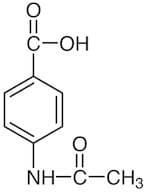
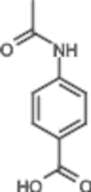
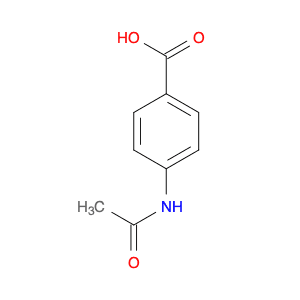
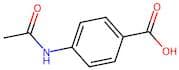
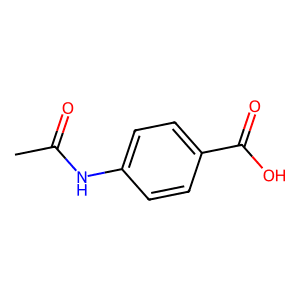
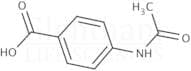
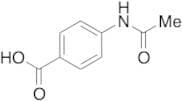
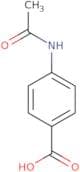
p-Acetamidobenzoic acid, also known as para-acetamidobenzoic acid, is an aromatic compound characterized by the presence of both an acetamido group and a carboxylic acid group attached to a benzene ring. Its molecular structure features a benzene ring substituted at the para position with an acetamido group (-NHCOCH3) and a carboxylic acid group (-COOH). This compound is typically a white crystalline solid and is soluble in polar solvents such as water and alcohols, while being less soluble in non-polar solvents. p-Acetamidobenzoic acid exhibits properties typical of both amides and carboxylic acids, including the ability to form hydrogen bonds, which contributes to its solubility and reactivity. It is often used in pharmaceutical applications and as an intermediate in organic synthesis. Additionally, it may exhibit biological activity, making it of interest in medicinal chemistry. Safety precautions should be taken when handling this compound, as with many organic chemicals, due to potential irritant properties.
Formula:C9H9NO3
InChI:InChI=1/C9H9NO3/c1-6(11)10-8-4-2-7(3-5-8)9(12)13/h2-5H,1H3,(H,10,11)(H,12,13)/p-1
InChI key:InChIKey=QCXJEYYXVJIFCE-UHFFFAOYSA-N
SMILES:N(C(C)=O)C1=CC=C(C(O)=O)C=C1
Synonyms:- 4-(Acetylamino)Benzoate
- 4-(Acetylamino)Benzoic Acid
- 4-Carboxyacetanilide
- Acedoben
- Acetylated PABA
- Benzoic acid, 4-(acetylamino)-
- Benzoic acid, p-acetamido-
- N-Acetyl-p-aminobenzoic acid
- NSC 4002
- P-Acetamido Benzoic acid
- Paaba
- p-(Acetoamino)benzoic acid
- p-Acetamidobenzoic acid
- p-Acetaminobenzoic acid
- p-Acetylamino benzoic acid
- 4-(ACETYLAMINO)BENZENECARBOXYLIC ACID
- P-ACETAMINOPHENYLCARBOXYLIC ACID
- N-ACETYL-PABA
- 4-(acetylamino)-benzoicaci
- P-ACETYLAMINOPHENYLCARBOXYLIC ACID
- 4-ACETAMIDOBENZOIC ACID
- P-ACETAMIDOPHENYLCARBOXYLIC ACID
- P-ACETYLAMIDOBENZOIC ACID
- N-ACETYL-1-AMINO-4-CARBOXYBENZENE
- 4-ACETYLAMINOBENZOIC ACID
- N-ACETYL-4-CARBOXYANILINE
- RARECHEM AL BO 0055
- N-(4-Carboxyphenyl)acetic acid amide
- See more synonyms
Sort by
Purity (%)
0
100
|
0
|
50
|
90
|
95
|
100
Found 11 products.
4-Acetamidobenzoic Acid
CAS:Formula:C9H9NO3Purity:>98.0%(T)Color and Shape:White to Almost white powder to crystalMolecular weight:179.184-Acetamidobenzoic acid, 98%
CAS:This Thermo Scientific Chemicals brand product was originally part of the Alfa Aesar product portfolio. Some documentation and label information may refer to the legacy brand. The original Alfa Aesar product / item code or SKU reference has not changed as a part of the brand transition to Thermo Sci
Formula:C9H9NO3Purity:98%Color and Shape:White to cream to pale gray, PowderMolecular weight:179.18Acedoben
CAS:Acedoben (4-acetamidobenzoic acid) is the acetyl derivative of para-aminobenzoic acid (PABA).Formula:C9H9NO3Purity:99.91%Color and Shape:Physical Description Needles Or Off-White Powder (Ntp 1992)Molecular weight:179.174-Acetamidobenzoic acid
CAS:4-Acetamidobenzoic acidFormula:C9H9NO3Purity:98%Color and Shape: white solidMolecular weight:179.17g/mol4-Acetamidobenzoic acid
CAS:Formula:C9H9NO3Purity:(Titration) ≥ 98.0%Color and Shape:White to off-white powder or crystalsMolecular weight:179.18Acedoben
CAS:Applications Acedoben is the acetylated derivative of p-aminobenzoic acid (PABA). Acedoben is a metabolite of the anesthetic Benzocaine (B202970).
References Song, D.-J. et al.: Biopharm. Drug Dispos., 20, 263 (1999); Hayton, W.L. et al.: Aquat. Toxicol., 36, 99 (1996);Formula:C9H9NO3Color and Shape:White To Off-WhiteMolecular weight:179.1734-Acetamidobenzoic acid
CAS:4-Acetamidobenzoic acid is an aromatic organic compound that is a precursor to many pharmaceuticals, such as acetaminophen, amoxicillin, dapsone, and sulfonamide. It is an intermediate in the formation of 4-hydroxybenzoic acid from benzoic acid. This molecule is also a component of some types of plastics. The chemical's structure and properties are determined by its coordination geometry, which consists of four nitrogen atoms and one hydroxyl group. 4-Acetamidobenzoic acid has been shown to inhibit the growth of certain bacteria by interfering with their metabolic activity. It has also been found to be active against several infectious diseases such as malaria and tuberculosis. The mechanism behind its effectiveness may be due to the fact that it inhibits bacterial fatty acid synthesis or prevents the production of ATP in mitochondria cells.br>br> br>br> The reaction solution was heated for 20 minutes at 100Formula:C9H9NO3Color and Shape:White PowderMolecular weight:179.17 g/mol