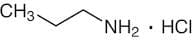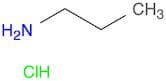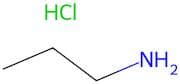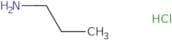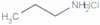
CAS 556-53-6
:Propylammonium chloride
Description:
Propylammonium chloride, with the CAS number 556-53-6, is an organic compound that belongs to the class of ammonium salts. It is characterized by the presence of a propyl group attached to an ammonium ion, resulting in a quaternary ammonium compound. This substance typically appears as a white crystalline solid and is soluble in water, which is a common trait for many ammonium salts. Propylammonium chloride is known for its hygroscopic nature, meaning it can absorb moisture from the environment. It is often used in various chemical applications, including as a reagent in organic synthesis and in the formulation of certain pharmaceuticals. The compound exhibits basic properties due to the presence of the ammonium ion, which can participate in acid-base reactions. Additionally, it may have applications in the field of biochemistry and materials science, where its ionic characteristics can be advantageous. Safety data should be consulted for handling and storage, as with any chemical substance.
Formula:C3H9N·ClH
InChI:InChI=1S/C3H9N.ClH/c1-2-3-4;/h2-4H2,1H3;1H
InChI key:InChIKey=PYNUOAIJIQGACY-UHFFFAOYSA-N
SMILES:C(CN)C.Cl
Synonyms:- 1-Aminopropane hydrochloride
- 1-Propanamine hydrochloride
- 1-Propanamine, Hydrochloride (1:1)
- 1-Propylammonium chloride
- Propan-1-amine hydrochloride (1:1)
- Propan-1-aminium chloride
- Propylamine, hydrochloride
- Propylammonium chloride
- n-Propylammonium chloride
Sort by
Purity (%)
0
100
|
0
|
50
|
90
|
95
|
100
Found 5 products.
Propylamine Hydrochloride
CAS:Formula:C3H9N·HClPurity:>98.0%(T)(N)Color and Shape:White to Almost white powder to crystalMolecular weight:95.57Propan-1-amine hydrochloride
CAS:Formula:C3H10ClNPurity:97%Color and Shape:SolidMolecular weight:95.5712Propylamine hydrochloride
CAS:Propylamine hydrochloride is a cationic surfactant that is used in pharmaceutical preparations. It has been shown to be effective against autoimmune diseases such as multiple sclerosis, rheumatoid arthritis, and chronic inflammatory bowel disease. The reactivity of propylamine hydrochloride with caproic acid has been studied through kinetic analysis and quantum mechanical calculations. This compound binds to the fatty acid receptor by hydrogen bonding and electrostatic forces. The basic structure of propylamine hydrochloride consists of two nitrogen atoms and one hydrogen atom bound to a carbon atom with three hydrogens attached to it. The reaction mechanism of propylamine hydrochloride involves the formation of an ion pair between the positively-charged nitrogen atoms and the negatively-charged oxygen atoms on the fatty acid receptor, leading to its binding.Formula:C3H9N·HClPurity:Min. 95%Molecular weight:95.57 g/mol