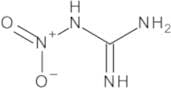
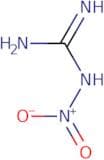
CAS 556-88-7
:Nitroguanidine
- 1-Nitroguanidin
- 1-Nitroguanidina
- 1-Nitroguanidine
- 2-Nitroguanidine
- Guanidine, 1-nitro-
- Guanidine, nitro-
- Lovex D 380
- N''-Nitroguanidine
- N1-Nitroguanidine
- N<sup>1</sup>-Nitroguanidine
- NQ
- Nsc 41036
- Picrite
- Picrite (propellant)
- a-Nitroguanidine
- guanidine, N-nitro-
- β-Nitroguanidine
- See more synonyms
Nitroguanidine 100 µg/mL in Acetonitrile
CAS:Controlled ProductFormula:CH4N4O2Color and Shape:Single SolutionMolecular weight:104.07Nitroguanidine (Wetted with water >20%)
CAS:Controlled ProductApplications Nitroguanidine is used in the prediction of heats of detonation of energetic compounds from their molecular structure. It is also used in the synthetic preparation of imidacloprid-d4 (I274992), which is a neonicotinoid.
E0
References Keshavarz, M.H., et al.: Propellant, Explosives, Pyrotechnics, 37, 93 (2012); Chauzat, M., et al.: Env. Entomol., 38, 514 (2009), Patial, A., et al.: Env. Ecol., 27, 320 (2009), Fernandez-Bayo, J., et al.: J. Agric., Food Chem., 57, 5435 (2009), Tomizawa, M., et al.: J. Med. Chem., 52, 3735 (2009), Chem. and Eng. News 90: 10 (2012)Formula:CH4N4O2Color and Shape:White To Off-WhiteMolecular weight:104.07Nitroguanidine
CAS:Controlled ProductNitroguanidine is a chemical compound that is used in wastewater treatment. Nitroguanidine has been shown to be effective in the removal of nitrates, sulfates, and other contaminants from water. It has also been shown to inhibit HIV infection by blocking the tyrosine kinase domain on CD4+ T-cells. Nitroguanidine can be used as a pharmacological treatment for various cancers such as skin cancer, leukemia, and lymphoma. In addition, nitroguanidine is able to inhibit the growth of tumors that have tyrosine kinase domains.
Nitroguanidine can be synthesized by reacting potassium dichromate with an organic methyl ethyl ketone precursor. The reaction produces nitric acid, which undergoes oxidation and reduction reactions to produce nitroso guanidine.Formula:CH4N4O2Purity:Min. 95%Molecular weight:104.07 g/mol