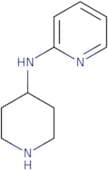
CAS 55692-31-4
:Piperidin-4-yl-pyridin-2-yl-amine
Description:
Piperidin-4-yl-pyridin-2-yl-amine, with the CAS number 55692-31-4, is a chemical compound characterized by its unique structure, which includes a piperidine ring and a pyridine moiety. This compound typically exhibits properties associated with both amines and heterocyclic compounds. It is often a white to off-white solid, soluble in polar organic solvents, and may have moderate stability under standard conditions. The presence of the piperidine ring contributes to its potential as a pharmacophore in medicinal chemistry, often influencing its biological activity and interaction with various receptors. The compound may exhibit basicity due to the amine functional group, allowing it to participate in hydrogen bonding and ionic interactions. Its structural features suggest potential applications in drug development, particularly in areas targeting neurological or psychiatric disorders. However, specific biological activities and safety profiles would require further investigation through empirical studies. As with all chemical substances, proper handling and safety precautions should be observed when working with this compound.
Formula:C10H15N3
InChI:InChI=1/C10H15N3/c1-2-6-12-10(3-1)13-9-4-7-11-8-5-9/h1-3,6,9,11H,4-5,7-8H2,(H,12,13)
SMILES:c1ccnc(c1)NC1CCNCC1
Synonyms:- 2-pyridinamine, N-4-piperidinyl-
- N-(Piperidin-4-yl)pyridin-2-amine
Sort by
Purity (%)
0
100
|
0
|
50
|
90
|
95
|
100
Found 2 products.
N-(Piperidin-4-yl)pyridin-2-amine
CAS:Triacetoxyborohydride is a reagent that is used in organic synthesis, especially for the reduction of esters and amides to alcohols. Triacetoxyborohydride reacts with an aralkyl group to produce a monocyclic hydrocarbon compound. It is also used in corrosion inhibition and as a corrosion inhibitor. The reactivity of triacetoxyborohydride is increased by the presence of sodium borohydride, which increases the number of reactive hydrogens on the boron atom.Formula:C10H15N3Purity:Min. 95%Molecular weight:177.25 g/mol