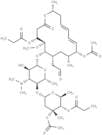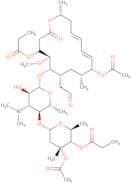
CAS 55881-07-7
:Miocamycin
Description:
Miocamycin is a macrolide antibiotic that is primarily derived from the fermentation of certain Streptomyces species. It exhibits antibacterial properties, particularly against Gram-positive bacteria, making it useful in treating various bacterial infections. The chemical structure of Miocamycin features a large lactone ring, which is characteristic of macrolides, and it contains multiple hydroxyl groups that contribute to its solubility and biological activity. This compound works by inhibiting bacterial protein synthesis, thereby preventing the growth and reproduction of bacteria. Miocamycin is often used in clinical settings for its effectiveness against respiratory tract infections and skin infections. Additionally, it may have some antifungal properties, although its primary application remains in antibacterial therapy. As with many antibiotics, the potential for resistance development is a concern, necessitating careful use and consideration of alternative treatments when appropriate. Overall, Miocamycin represents an important tool in the arsenal against bacterial infections, particularly in cases where other antibiotics may be less effective.
Formula:C45H71NO17
InChI:InChI=1S/C45H71NO17/c1-13-34(50)59-33-23-36(52)55-26(4)18-16-15-17-19-32(58-29(7)48)25(3)22-31(20-21-47)41(42(33)54-12)62-44-39(53)38(46(10)11)40(27(5)57-44)61-37-24-45(9,63-30(8)49)43(28(6)56-37)60-35(51)14-2/h15-17,19,21,25-28,31-33,37-44,53H,13-14,18,20,22-24H2,1-12H3/b16-15+,19-17+/t25-,26-,27-,28+,31+,32+,33-,37+,38-,39-,40-,41+,42+,43+,44+,45-/m1/s1
InChI key:InChIKey=GQNZGCARKRHPOH-RQIKCTSVSA-N
SMILES:O([C@@H]1[C@@H](OC)[C@H](OC(CC)=O)CC(=O)O[C@H](C)C\C=C\C=C\[C@H](OC(C)=O)[C@H](C)C[C@@H]1CC=O)[C@H]2[C@H](O)[C@@H](N(C)C)[C@H](O[C@H]3C[C@](OC(C)=O)(C)[C@@H](OC(CC)=O)[C@H](C)O3)[C@@H](C)O2
Synonyms:- (4R,5S,6S,7S,9R,10R,11E,13E,16R)-10-(acetyloxy)-6-{[(2S,3R,4R,5S,6R)-5-{[(2S,4R,5S,6S)-4-(acetyloxy)-4,6-dimethyl-5-(propanoyloxy)tetrahydro-2H-pyran-2-yl]oxy}-4-(dimethylamino)-3-hydroxy-6-methyltetrahydro-2H-pyran-2-yl]oxy}-5-methoxy-9,16-dimethyl-2-oxo-7-(2-oxoethyl)oxacyclohexadeca-11,13-dien-4-yl propanoate (non-preferred name)
- 3′′,9-Diacetylmydecamycin
- 9,3′′-Di-O-acetylmidecamycin
- Acecamycin
- Leucomycin V, 3<sup>B</sup>,9-diacetate 3,4<sup>B</sup>-dipropanoate
- Mikamycin
- Miocamycin
- Miokamycin
- Oxacyclohexadecane, leucomycin V deriv.
- Ponsinomycin
- Mom
- See more synonyms
Sort by
Purity (%)
0
100
|
0
|
50
|
90
|
95
|
100
Found 2 products.
Midecamycin acetate
CAS:Midecamycin acetate is a broad-spectrum antibiotic active against Gram-positive and some Gram-negative strains.Formula:C45H71NO17Purity:98%Color and Shape:White Or Offt-White Crystalline PowderMolecular weight:898.04Midecamycin acetate
CAS:Midecamycin is the active form of midecamycin acetate. It is an antibiotic that has been used mainly in the treatment of inflammatory bowel disease, although it has also been used to treat streptococcal pharyngitis and other bacterial infections. Midecamycin acetate binds to DNA gyrase and topoisomerase IV, which are enzymes that maintain the integrity of bacterial DNA. This binding prevents the formation of an antibiotic-inhibitor complex with the enzyme cell wall synthesis that is required for cell wall biosynthesis, inhibiting protein synthesis and cell division. Midecamycin acetate may have clinical relevance in infectious diseases such as human serum and monoclonal antibody production. There are no toxicity studies available for this drug at this time. Midecamycin acetate may cause side effects such as nausea, vomiting, diarrhea, abdominal pain, fever, headache or rash.br>br>Formula:C45H71NO17Purity:Min. 95%Molecular weight:898.04 g/mol