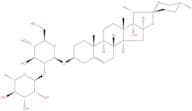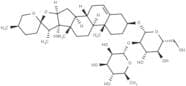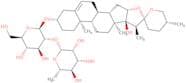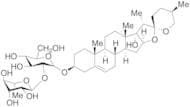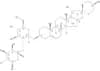
CAS 55916-51-3
:Polyphyllin VI
Description:
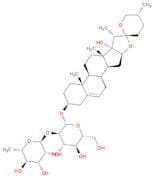
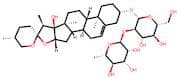
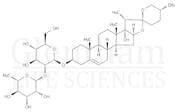
Polyphyllin VI is a natural steroidal saponin primarily derived from the plant species of the genus Paris, particularly Paris polyphylla. It is characterized by its complex molecular structure, which includes a steroid backbone and multiple sugar moieties, contributing to its saponin properties. This compound is known for its potential pharmacological activities, including anti-inflammatory, anticancer, and immunomodulatory effects. Polyphyllin VI exhibits a range of biological activities, which have garnered interest in medicinal chemistry and pharmacology. Its mechanism of action often involves the induction of apoptosis in cancer cells and modulation of various signaling pathways. Additionally, due to its saponin nature, it can exhibit surfactant properties, influencing membrane permeability. However, the use of Polyphyllin VI in therapeutic applications requires careful consideration of its bioavailability and potential toxicity. As research continues, further elucidation of its pharmacokinetics and mechanisms of action may enhance its applicability in clinical settings.
Formula:C39H62O13
InChI:InChI=1S/C39H62O13/c1-18-8-13-38(47-17-18)20(3)39(46)27(52-38)15-25-23-7-6-21-14-22(9-11-36(21,4)24(23)10-12-37(25,39)5)49-35-33(31(44)29(42)26(16-40)50-35)51-34-32(45)30(43)28(41)19(2)48-34/h6,18-20,22-35,40-46H,7-17H2,1-5H3/t18-,19+,20-,22+,23-,24+,25+,26-,27+,28+,29-,30-,31+,32-,33-,34+,35-,36+,37+,38-,39-/m1/s1
InChI key:InChIKey=WHWWQGPCTUQCMN-JDDKMXSSSA-N
SMILES:O[C@@]12[C@]3(C)[C@@](C[C@@]1(O[C@@]4([C@H]2C)CC[C@@H](C)CO4)[H])([C@]5([C@](CC3)([C@]6(C)C(=CC5)C[C@@H](O[C@H]7[C@H](O[C@H]8[C@H](O)[C@H](O)[C@@H](O)[C@H](C)O8)[C@@H](O)[C@H](O)[C@@H](CO)O7)CC6)[H])[H])[H]
Synonyms:- (3β,25R)-17-Hydroxyspirost-5-en-3-yl 2-O-(6-deoxy-α-<span class="text-smallcaps">L</smallcap>-mannopyranosyl)-β-<smallcap>D</span>-glucopyranoside
- 17-Hydroxyparis V
- Paris VI
- Paris saponin VI
- ParisVI
- Pennogenin 3-O-a-L-rhamnopyranosyl-(1® 2)-b-D-glucopyranoside
- Pennogenin 3-O-α-<span class="text-smallcaps">L</smallcap>-rhamnopyranosyl-(1→2)-β-<smallcap>D</span>-glucopyranoside
- Pennogenin-3-O-α-<span class="text-smallcaps">L</smallcap>-rhamnopyranosyl(1→2)-β-<smallcap>D</span>-glucoside
- Polygonatoside B3
- Polygonatoside B<sup>3</sup>
- Polyphyllin VI
- Saponin Tb
- β-<span class="text-smallcaps">D</smallcap>-Glucopyranoside, (3β,25R)-17-hydroxyspirost-5-en-3-yl 2-O-(6-deoxy-α-<smallcap>L</span>-mannopyranosyl)-
- Pennogenin 3-O-α-L-rhamnopyranosyl-(1→2)-β-D-glucopyranoside
- β-D-Glucopyranoside, (3β,25R)-17-hydroxyspirost-5-en-3-yl 2-O-(6-deoxy-α-L-mannopyranosyl)-
- See more synonyms
Sort by
Purity (%)
0
100
|
0
|
50
|
90
|
95
|
100
Found 8 products.
Polyphyllin VI
CAS:1. Polyphyllin VI has hemostasis , expectorant , bacteriostasis, anticytotoxic, anti pregnancy kill sperm effects.Formula:C39H62O13Purity:99.69% - 99.72%Color and Shape:SolidMolecular weight:738.90Ref: TM-T6S2315
1mg37.00€5mg71.00€10mg90.00€25mg147.00€50mg208.00€100mg309.00€200mg447.00€1mL*10mM (DMSO)103.00€Polyphyllin VI
CAS:Polyphyllin VI is a natural compound that belongs to the class of polyphyllins. It is a reactive compound with a p-gp substrate and mitochondrial membrane potential. Polyphyllin VI has been shown to be an effective inhibitor of bacterial growth and is clinically relevant in the treatment of bacterial infections. This drug also inhibits the synthesis of fatty acids, which may cause it to exhibit anti-inflammatory effects due to its ability to inhibit prostaglandin synthesis. Polyphyllin VI also shows antioxidant properties, which may be due to its ability to scavenge free radicals and protect cells from oxidative damage.Formula:C39H62O13Purity:Min. 95%Color and Shape:PowderMolecular weight:738.9 g/molPolyhyllin VI
CAS:Controlled ProductApplications Polyhyllin VI is a natural saponin extracted from the plant, Rhizoma Paridis, and displays anti-proliferative activity in vivo. Used in the treatment of HepG2 cells for tumor mitigation.
References Ma, D. et al.: J. Int Med. Res., 37, 631 (2009); Yin, X. et al.: Biomed. Chrom., 27, 343 (2013); Jiang, H. et al.: Mol. Med. Rep., 9, 2265 (2014); Cheng, Z. et al.: J. Ethnopharmacol., 120, 129 (2008);Formula:C39H62O13Color and Shape:NeatMolecular weight:738.9