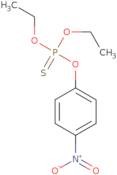
CAS 56-38-2
:Parathion
Description:
Parathion, with the CAS number 56-38-2, is an organophosphate insecticide known for its potent neurotoxic effects. It is a colorless to pale yellow liquid with a characteristic odor, often described as similar to that of rotten eggs. Parathion functions by inhibiting the enzyme acetylcholinesterase, leading to an accumulation of acetylcholine in the nervous system, which can result in overstimulation of muscles and glands. This mechanism makes it highly effective as an insecticide but also poses significant risks to human health and the environment. Parathion is classified as highly toxic, and exposure can occur through inhalation, ingestion, or skin contact. Due to its hazardous nature, many countries have restricted or banned its use. In terms of physical properties, Parathion has a relatively low solubility in water but is soluble in organic solvents. Its persistence in the environment raises concerns regarding its potential for bioaccumulation and long-term ecological impact. Proper handling and safety measures are essential when dealing with this chemical.
Formula:C10H14NO5PS
InChI:InChI=1S/C10H14NO5PS/c1-3-14-17(18,15-4-2)16-10-7-5-9(6-8-10)11(12)13/h5-8H,3-4H2,1-2H3
InChI key:InChIKey=LCCNCVORNKJIRZ-UHFFFAOYSA-N
SMILES:P(OC1=CC=C(N(=O)=O)C=C1)(OCC)(OCC)=S
Synonyms:- AAT
- Aatp
- Alkron
- Alleron
- American Cyanamid 3422
- Aphamite
- Aralo
- Bay 1605
- Bayer E-605
- Bladan F
- Diethyl 4-nitrophenyl phosphorothioate
- Diethyl p-nitrophenyl phosphorothionate
- Diethyl p-nitrophenyl thionophosphate
- Diethyl parathion
- Dntp
- E 605
- E 605F
- E 605Ft20
- Ecatox 20
- Ekatox
- Ekatox 20
- Ent 15108
- Ethyl parathion
- Etilon
- Folidol
- Folidol E
- Folidol E-605
- Folidol oil
- Fosferno
- Fostox
- Galpar
- Gearphos
- Lirothion
- Na 2783
- Niran
- Nitrostigmine
- Niuif 100
- Nourithion
- Nsc 8933
- O,O-Diethyl O-(4-nitrophenyl) phosphorothioate
- O,O-Diethyl O-(p-nitrophenyl) phosphorothioate
- O,O-Diethyl O-p-nitrophenyl thiophosphate
- Oleofos 20
- Oleoparathene
- Oleoparathion
- Pacol
- Paramar 50
- Paraphos
- Parathene
- Parathion
- Parathion A
- Parathion [Phosphorothioic acid, O,O-diethyl-O-(4-nitrophenyl)ester]
- Parathion-ethyl
- Paration
- Penncap E
- Phospherno
- Phosphorothioic acid O,O-diethyl O-(4-nitrophenyl)ester
- Phosphorothioic acid, O,O-diethyl O-(p-nitrophenyl) ester
- RB
- Rhodiasol
- Rhodiatox
- Selephos
- Super Rodiatox
- Thiomex
- Thiophos
- Thiophos 3422
- See more synonyms
Sort by
Purity (%)
0
100
|
0
|
50
|
90
|
95
|
100
Parathion-ethyl 100 µg/mL in Acetonitrile
CAS:Controlled ProductFormula:C10H14NO5PSColor and Shape:Single SolutionMolecular weight:291.26Parathion-ethyl 10 µg/mL in Acetonitrile
CAS:Controlled ProductFormula:C10H14NO5PSColor and Shape:Single SolutionMolecular weight:291.26Parathion-ethyl 100 µg/mL in Cyclohexane
CAS:Controlled ProductFormula:C10H14NO5PSColor and Shape:Single SolutionMolecular weight:291.26Parathion
CAS:Controlled Product<p>Stability Hygroscopic, Moisture Sensitive<br>Applications Parathion is an organophosphate insecticide used on cotton, rice and fruit trees.<br> Not a dangerous good if item is equal to or less than 1g/ml and there is less than 100g/ml in the package<br>References Seifert, J., et al.: Environ. Toxicol. Pharmacol., 35, 200 (2013); Ciffroy, P., et al.: Environ. Toxicol. Chem., 32, 602 (2013);<br></p>Formula:C10H14NO5PSColor and Shape:YellowMolecular weight:291.26Parathion-ethyl
CAS:Controlled Product<p>Parathion-ethyl is a member of the organophosphate class of pesticides. It inhibits acetylcholinesterase and is used to control insects in agriculture, homes, and other areas. The compound can be detected by both the polymerase chain reaction (PCR) and the in vitro method for detecting enzyme activities. Parathion-ethyl has been shown to have minimal toxicity in animal studies, with acute toxicities ranging from mild to moderate. This pesticide has been shown to inhibit signal peptide cleavage and energy metabolism in cells. It also inhibits transcriptional activity when it binds to DNA, which may be due to its interaction with enzymes that are involved in transcriptional regulation or chromatographic analysis. Parathion-ethyl also has minimal toxicity in animals and shows acute toxicities ranging from mild to moderate. It has been shown to inhibit signal peptide cleavage and energy metabolism as well as transcriptional activity when it binds to DNA, possibly due to its interactions with</p>Formula:C10H14NO5PSPurity:Min. 95%Molecular weight:291.26 g/molParathion-ethyl 100 µg/mL in Acetone
CAS:Controlled ProductFormula:C10H14NO5PSColor and Shape:Single SolutionMolecular weight:291.26