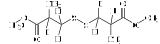
CAS 56-89-3
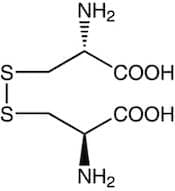
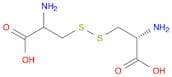
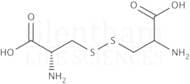
:(-)-Cystine
Description:
(-)-Cystine, with the CAS number 56-89-3, is a naturally occurring amino acid that plays a crucial role in protein structure and function. It is a dimeric form of cysteine, formed by the oxidation of two cysteine molecules, resulting in a disulfide bond between their thiol groups. This compound is characterized by its white crystalline appearance and is soluble in water, which facilitates its biological functions. (-)-Cystine is essential for the stability of protein structures, particularly in the formation of tertiary and quaternary structures due to its ability to form disulfide bridges. It is also involved in various metabolic processes and is important for the synthesis of glutathione, a key antioxidant in the body. In terms of its biological significance, (-)-Cystine is found in many proteins and is vital for maintaining the redox balance within cells. Its presence is particularly noted in keratin, which is a major component of hair, skin, and nails. Overall, (-)-Cystine is integral to numerous physiological processes and contributes to the structural integrity of proteins.
Formula:C6H12N2O4S2
InChI:InChI=1/C3H6NO2S3/c5-3(6)2(4-7)1-9-8/h2H,1,4H2,(H,5,6)
InChI key:InChIKey=LEVWYRKDKASIDU-IMJSIDKUSA-N
SMILES:[C@H](CSSC[C@@H](C(O)=O)N)(C(O)=O)N
Synonyms:- (-)-3,3-Dithiobis(2-aminopropionic acid)
- (2R,2'S)-3,3'-disulfanediylbis(2-ammoniopropanoate)
- (H-Cys-OH)2
- (H-Cys-OH)2 (Disulfide bond)
- 2-Amino-3-[(2-amino-2-carboxyethyl)dithio]propanoic acid
- 3,3'-Dithiobis(2-aminopropanoic acid)
- <span class="text-smallcaps">L</span>-(-)-Cystine
- <span class="text-smallcaps">L</span>-Alanine, 3,3′-dithiobis-
- <span class="text-smallcaps">L</span>-Cysteine disulfide
- <span class="text-smallcaps">L</span>-Cystin
- Alanine, 3,3'-dithiobis-
- Bis(β-amino-β-carboxyethyl) disulfide
- Cistina
- Cystin
- Cystine
- Cystine acid
- Cystine, <span class="text-smallcaps">L</span>-
- Cystine, L-
- Dicysteine
- H-(Cys)_2-OH
- L(-)-3,3-Dithiobis(2-aminopropanoic acid)
- L-(-)-Cysteine
- L-Alanine, 3,3'-dithiobis-
- L-Cysteine disulfide
- L-Cystin
- L-Cystine, synthetically derived
- L-Cystine,food grade
- Nsc 13203
- Oxidized <span class="text-smallcaps">L</span>-cysteine
- Oxidized L-cysteine
- Propanoic acid, 3,3'-dithiobis[2-amino-, [R-(R*,R*)]-
- [R-(R*,R*)]-3,3'-Dithiobis[2-aminopropanoic acid]
- β,β'-Diamino-β,β'-dicarboxydiethyl disulfide
- β,β'-Dithiodialanine
- L-Cystine
- (R,R)-3,3'-DITHIOBIS(2-AMINOPROPIONIC ACID)
- (R)-(-)-CYSTINE
- L-CYTISINE
- (r-(r*,r*))-3,3’-dithiobis(2-aminopropanoicacid)
- L-CYSTINE BASE
- 3,3’-dithiobis(2-aminopropanoicacid)
- H-L-CYSTINE
- 3,3’-dithiobis-l-alanin
- BETA,BETA'-DITHIOBIS-A-AMINOPROPIONIC ACID
- (R,R)-(-)-CYSTINE
- 3,3’-dithiobis(2-amino-,(r-(r*,r*))-propanoicaci
- 1-cystine
- See more synonyms
Sort by
Purity (%)
0
100
|
0
|
50
|
90
|
95
|
100
L-(-)-Cystine
CAS:Formula:C6H12N2O4S2Purity:>98.0%(HPLC)(N)Color and Shape:White powder to crystalineMolecular weight:240.29L-Cystine, 99%
CAS:L-Cystine is used as an antioxidant, protecting tissues against radiation and pollution. It finds application in protein synthesis. It is required for utilization of vitamin B6 and is useful in healing burns and wounds. It is also is required by certain malignant cell lines in the culture medium asFormula:C6H12N2O4S2Purity:99%Color and Shape:White to pale cream, Crystals or powder or crystalline powderMolecular weight:240.29L-Cystine, Cell Culture Reagent
CAS:L-cysteine acts as a major source of sulfur in cell culture. Cysteine has been used in pulse-chase experiments to study protein expression from an inducible promoter. L-Cysteine is used to supplement cell culture media. This Thermo Scientific Chemicals brand product was originally part of the Alfa AFormula:C6H12N2O4S2Color and Shape:White, Crystals or crystalline powderMolecular weight:240.29Cystine
CAS:Other organo-sulfur acid compoundsFormula:C6H12N2O4S2Color and Shape:White Crystalline PowderMolecular weight:240.02385L-Cystine, non-animal origin, Ph. Eur. grade
CAS:Formula:C6H12N2O4S2Color and Shape:White or almost white crystalline powderMolecular weight:240.30L-Cystine
CAS:L-CystineFormula:C6H12N2O4S2Purity:99% (Typical Value in Batch COA)Color and Shape: white powderMolecular weight:240.30g/molL-Cystine, non-animal origin
CAS:Formula:C6H12N2O4S2Purity:≤ 0.2%Color and Shape:White or almost white crystalline powderMolecular weight:240.30L-Cystine
CAS:Formula:C6H12N2O4S2Purity:98.5 - 101.0 %Color and Shape:White crystalline powderMolecular weight:240.30L-Cystine
CAS:L-Cystine (Cystine Acid) is not considered one of the 20 amino acids, L-Cystine (Cystine Acid) is a sulfur-containing derivative obtained from oxidation ofFormula:C6H12N2O4S2Purity:99.59% - 99.85%Color and Shape:White Solid PowderMolecular weight:240.30L-Cystine
CAS:Impurity Acetylcysteine EP Impurity A
Applications L-Cystine is a non-essential amino acid for human development. L-Cystine is formed by the dimerization of two cysteines through the sulfur. Acetylcysteine EP Impurity A
References Fahey, R.C., et al.: J. Mol. Evol., 10, 155 (1977), Kao, P., et al.: J. Biol.Chem., 261, 8085 ( 1986), Nicke, A., et al.: J. Biol. Chem., 278, 3137 (2003),Formula:C6H12N2O4S2Color and Shape:WhiteMolecular weight:240.3