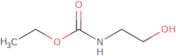
CAS 5602-93-7
:ethyl (2-hydroxyethyl)carbamate
Description:
Ethyl (2-hydroxyethyl)carbamate, also known as ethyl carbamate or urethane, is an organic compound characterized by its carbamate functional group. It is a colorless, viscous liquid with a slightly sweet odor and is soluble in water and organic solvents. The molecular structure features an ethyl group attached to a carbamate moiety, which includes a hydroxyl group, contributing to its hydrophilicity. Ethyl carbamate is primarily used in the synthesis of pharmaceuticals and as a solvent in various chemical reactions. It is also noted for its presence in fermented beverages, where it can form as a byproduct of fermentation processes. While it has applications in industry, ethyl carbamate is subject to regulatory scrutiny due to its potential carcinogenic properties, necessitating careful handling and usage guidelines. Its stability under normal conditions makes it a useful compound in laboratory settings, but it should be stored away from strong acids and bases to prevent degradation.
Formula:C5H11NO3
InChI:InChI=1/C5H11NO3/c1-2-9-5(8)6-3-4-7/h7H,2-4H2,1H3,(H,6,8)
SMILES:CCOC(=NCCO)O
Synonyms:- carbamic acid, N-(2-hydroxyethyl)-, ethyl ester
Sort by
Purity (%)
0
100
|
0
|
50
|
90
|
95
|
100
Found 2 products.
Ethyl N-(2-hydroxyethyl)carbamate
CAS:Ethyl N-(2-hydroxyethyl)carbamate is a carbamate insecticide that is used in agriculture and horticultural industries to control lepidopteran insects. It is a metabolite of methoprene, which is an insect growth regulator. The ethyl group of ethyl N-(2-hydroxyethyl)carbamate is conjugated with the hydroxyl group of the 2-hydroxyethylamine moiety. This results in the formation of an antigenic site for antibody production, enhancing immunosorbent assays for determination of methoprene residues in plants or animal tissues.Formula:C5H11NO3Purity:Min. 95%Molecular weight:133.15 g/mol