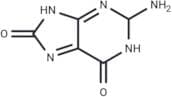
CAS 5614-64-2
:8-Oxoguanine
Description:
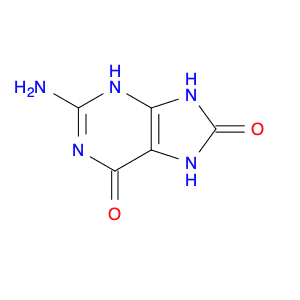
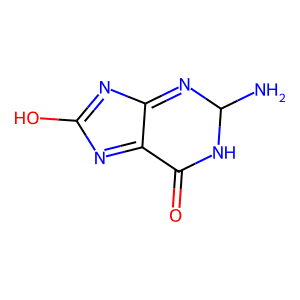
8-Oxoguanine, with the CAS number 5614-64-2, is a modified nucleobase derived from guanine, one of the four primary building blocks of DNA. It is characterized by the presence of a carbonyl group at the 8-position of the purine ring, which results from oxidative damage to DNA. This modification can lead to mispairing during DNA replication, potentially causing mutations. 8-Oxoguanine is known for its role in the cellular response to oxidative stress and is often used as a biomarker for oxidative DNA damage. In terms of solubility, it is generally soluble in water and various organic solvents, making it accessible for biochemical studies. The compound can participate in various chemical reactions, including those involving nucleophiles, and is of significant interest in cancer research due to its implications in mutagenesis and the aging process. Its presence in DNA can trigger repair mechanisms, highlighting its importance in maintaining genomic integrity.
Formula:C5H5N5O2
InChI:InChI=1S/C5H5N5O2/c6-4-8-2-1(3(11)10-4)7-5(12)9-2/h(H5,6,7,8,9,10,11,12)
InChI key:InChIKey=CLGFIVUFZRGQRP-UHFFFAOYSA-N
SMILES:O=C1C2=C(NC(=O)N2)NC(N)=N1
Synonyms:- 1H-Purine-6,8-dione, 2-amino-7,9-dihydro-
- 2-Amino-6,8-purinediol
- 2-Amino-7,9-dihydro-1H-purine-6,8-dione
- 2-Amino-8-hydroxy-1H-purin-6(7H)-one
- 2-Amino-8-hydroxy-6,9-dihydro-1H-purin-6-one
- 2-Aminopurin-6,8-diol
- 2-Aminopurina-6,8-Diol
- 2-Aminopurine-6,8-Diol
- 2-amino-3H-purine-6,8-dione
- 2-amino-7,9-dihydro-3H-purine-6,8-dione
- 7,8-Dihydro-8-oxoguanine
- 8-Hydroxyguanine
- 8-Oxo-7,8-dihydroguanine
- 8-Oxoguanine
- Nsc 22720
- Purine-6,8(1H,9H)-dione, 2-amino-
- See more synonyms
Sort by
Purity (%)
0
100
|
0
|
50
|
90
|
95
|
100
Found 8 products.
2-Amino-6,8-dihydroxypurine
CAS:Formula:C5H5N5O2Purity:95%Color and Shape:SolidMolecular weight:167.1255Ref: IN-DA00D7YF
1mg182.00€5mg320.00€10mg633.00€25mgTo inquire50mgTo inquire100mg200.00€500mgTo inquire8-Hydroxyguanine
CAS:8-Hydroxyguanine is a purine derivative that is found in DNA. It is a byproduct of oxidative damage to DNA and can cause mutations. 8-Hydroxyguanine binds to the α1 subunit of DNA polymerase, inhibiting the polymerization of nucleotides. This prevents the synthesis of new DNA, resulting in cell death. In humans, 8-hydroxyguanine appears to be repaired at a higher rate than other organisms such as bacteria. A study has shown that human cells are able to repair 8-hydroxyguanine by using an enzyme called O6-alkylguanine transferase (AGT). The AGT protein removes the alkyl group from the guanine base and replaces it with an amino group during repair. This process results in the formation of O6-methylguanine, which can be eliminated by methylation or excreted through urine.Formula:C5H5N5O2Purity:Min. 98 Area-%Color and Shape:White PowderMolecular weight:167.13 g/mol8-Hydroxyguanine
CAS:8-Hydroxyguanine: main damage by oxygen species, causes G-T/A-C mutations, marker for RNA/DNA oxidation, mutagenic and carcinogenic.Formula:C5H5N5O2Purity:99.72%Color and Shape:SolidMolecular weight:167.13