CAS 56172-71-5
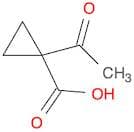
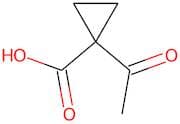
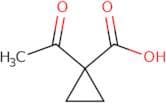
:1-acetylcyclopropanecarboxylic acid
Description:
1-Acetylcyclopropanecarboxylic acid is an organic compound characterized by its cyclopropane ring structure, which is a three-membered carbon ring. This compound features both an acetyl group and a carboxylic acid functional group, contributing to its reactivity and potential applications in organic synthesis. The presence of the carboxylic acid group imparts acidic properties, allowing it to participate in various chemical reactions, such as esterification and amidation. Additionally, the acetyl group can serve as a protective group in synthetic pathways. The compound is typically a colorless to pale yellow liquid or solid, depending on its purity and specific conditions. Its unique structure makes it of interest in the fields of medicinal chemistry and materials science, where it may be explored for its biological activity or as a building block for more complex molecules. Safety data should be consulted for handling, as with any chemical substance, to ensure proper precautions are taken.
Formula:C6H8O3
InChI:InChI=1/C6H8O3/c1-4(7)6(2-3-6)5(8)9/h2-3H2,1H3,(H,8,9)
SMILES:CC(=O)C1(CC1)C(=O)O
Synonyms:- Acetylcyclopropane-1-carboxylic acid
- 1-Acetylcyclopropanecarboxylic acid
Sort by
Purity (%)
0
100
|
0
|
50
|
90
|
95
|
100
Found 3 products.
CYCLOPROPANECARBOXYLIC ACID, 1-ACETYL-
CAS:Formula:C6H8O3Purity:95%Color and Shape:LiquidMolecular weight:128.12591-Acetylcyclopropane-1-carboxylic acid
CAS:<p>1-Acetylcyclopropane-1-carboxylic acid</p>Purity:≥95%Color and Shape:SolidMolecular weight:128.13g/mol1-Acetylcyclopropane-1-carboxylic acid
CAS:1-Acetylcyclopropane-1-carboxylic acid is a dicarboxylic acid that is produced by the alkylation of chloride with triethylbenzylammonium. It can be used to produce cyclopropanol, which can undergo an annulation reaction to form cyclopropylcarbinols. 1-Acetylcyclopropane-1-carboxylic acid has been shown to undergo rearrangement reactions in the presence of sodium hydroxide, and has been shown to be a good substrate for nucleophilic substitution reactions. This chemical also undergoes esterification with alcohols to form esters.Formula:C6H8O3Purity:Min. 95%Molecular weight:128.13 g/mol