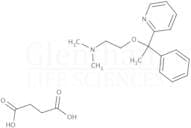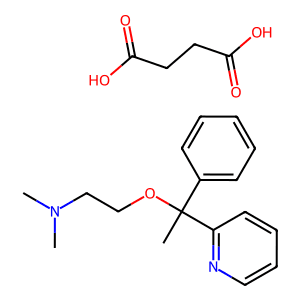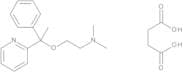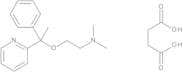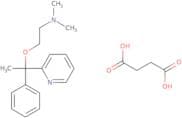
CAS 562-10-7
:Donormil
- 2-[α-(2-Dimethylaminoethoxy)-α-methylbenzyl]pyridine succinate
- 2-[α-(2-Dimethylaminoethoxy)-α-methylbenzyl]pyridine succinate (1:1)
- Alsodorm
- Butanedioic acid, compd. with N,N-dimethyl-2-[1-phenyl-1-(2-pyridinyl)ethoxy]ethanamine (1:1)
- Decamium
- Decapryn
- Decapryn succinate
- Decapryn succinate (1:1)
- Donormil
- Donormyl
- Dormidina
- Doxised
- Doxylamine Hydrogen Succinate
- Ethanamine, N,N-dimethyl-2-[1-phenyl-1-(2-pyridinyl)ethoxy]-, butanedioate (1:1)
- Gittalun
- Hoggar N
- Meraprina
- Mereprine
- N,N-dimethyl-2-[1-phenyl-1-(pyridin-2-yl)ethoxy]ethanamine
- N,N-dimethyl-2-[1-phenyl-1-(pyridin-2-yl)ethoxy]ethanamine butanedioate (1:1)
- NSC 74772
- Pyridine, 2-[α-[2-(dimethylamino)ethoxy]-α-methylbenzyl]-, succinate (1:1)
- Sedaplus
- Succinic acid, compd. with 2-[α-[2-(dimethylamino)ethoxy]-α-methylbenzyl]pyridine (1:1)
- See more synonyms
Doxylamine Hydrogen Succinate 1.0 mg/ml in Methanol (as free base)
CAS:Color and Shape:Single SolutionDOXYLAMINE FOR SYSTEM SUITABILITY CRS
CAS:DOXYLAMINE FOR SYSTEM SUITABILITY CRSFormula:C17H22N2OMolecular weight:270.3694DOXYLAMINE HYDROGEN SUCCINATE CRS
CAS:DOXYLAMINE HYDROGEN SUCCINATE CRSFormula:C17H22N2OMolecular weight:270.3694Doxylamine Succinate
CAS:Compounds containing an unfused pyridine ring in the structure, nesoiFormula:C17H22N2O·C4H6O4Color and Shape:White Cream PowderMolecular weight:388.19982Butanedioic acid, compd. withN,N-dimethyl-2-[1-phenyl-1-(2-pyridinyl)ethoxy]ethanamine (1:1)OTHER CA INDEX NAMES:Ethanamine, N,N-dimethyl-2-[1-phenyl-1-(2-pyridinyl)ethoxy]-,butanedioate (1:1)
CAS:Formula:C21H28N2O5Purity:99%Color and Shape:SolidMolecular weight:388.4574Doxylamine succinate
CAS:Doxylamine Succinate is a pyridine derivate histamine H1 antagonist with pronounced sedative properties.Formula:C21H28N2O5Purity:99.61%Color and Shape:5 1 (Ntp 1992)Molecular weight:388.46Doxylamine succinate salt
CAS:Formula:C17H22N2O·C4H6O4Purity:≤ 1.0%Color and Shape:White to off-white powderMolecular weight:388.46Doxylamine Succinate
CAS:Formula:C17H22N2O·C4H6O4Purity:>98.0%(T)(HPLC)Color and Shape:White to Almost white powder to crystalMolecular weight:388.46Doxylamine Succinate
CAS:Controlled ProductFormula:C17H22N2O·C4H6O4Color and Shape:Off-WhiteMolecular weight:388.46Doxylamine succinate
CAS:Controlled ProductDoxylamine succinate is a pharmaceutically active ingredient that is used as an antihistamine and sedative. It is a white, odorless powder with a bitter taste. Doxylamine succinate has been shown to have high resistance to degradation by gastric acid, which is why it can be administered orally or intranasally. The in vitro method of measuring the release of drug from the dosage form has been used to measure the pharmacological treatment time. In this study, doxylamine succinate was found to have a fast onset of action and short duration of action. Excipients such as metoprolol succinate and sucrose are also added to the dosage form. Toxicological studies on animals have shown liver lesions at high doses, so this drug should be taken at low doses for shorter periods of time when possible. A concentration-time curve was generated using statistical methods to control for biological variability between mice.
Formula:C17H22N2O•C4H6O4Purity:Min. 95%Color and Shape:PowderMolecular weight:388.46 g/mol


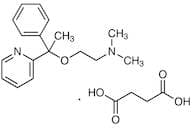
![Butanedioic acid, compd. withN,N-dimethyl-2-[1-phenyl-1-(2-pyridinyl)ethoxy]ethanamine (1:1)OTHER …](/_next/image/?url=https%3A%2Fstatic.cymitquimica.com%2Fproducts%2FIN%2Fthumb%2FDA00IA19.jpg&w=3840&q=75)