CAS 5621-13-6
:2,7-dimethyl-1H-indole
Description:
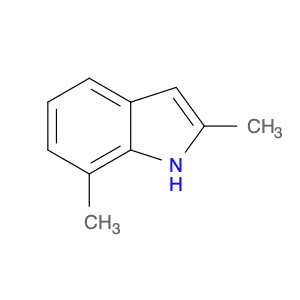
2,7-Dimethyl-1H-indole is an organic compound characterized by its indole structure, which consists of a fused benzene and pyrrole ring. This compound features two methyl groups attached to the indole ring at the 2 and 7 positions, contributing to its unique chemical properties. It is a colorless to pale yellow liquid with a characteristic odor and is relatively soluble in organic solvents. The presence of the methyl groups can influence its reactivity and stability, making it an interesting compound for various chemical applications, including synthesis in organic chemistry and potential use in pharmaceuticals. 2,7-Dimethyl-1H-indole can participate in electrophilic aromatic substitution reactions due to the electron-donating nature of the methyl groups, enhancing its reactivity. Additionally, it may exhibit biological activity, which has been a subject of research in the fields of medicinal chemistry and biochemistry. Safety data should be consulted for handling and usage, as with any chemical substance.
Formula:C10H11N
InChI:InChI=1/C10H11N/c1-7-4-3-5-9-6-8(2)11-10(7)9/h3-6,11H,1-2H3
SMILES:Cc1cccc2cc(C)[nH]c12
Synonyms:- 1H-indole, 2,7-dimethyl-
- Indole, 2,7-dimethyl-
Sort by
Purity (%)
0
100
|
0
|
50
|
90
|
95
|
100
Found 4 products.
2,7-Dimethyl-1H-indole
CAS:2,7-Dimethyl-1H-indole (3,4-dimethylaniline) is a nitrogenous organic compound that is used in the synthesis of trifluoride and dipyrroles. 3,4-Dimethylaniline can be synthesized by the reaction of 2,7-dimethylindole with magnesium metal and a halogenated hydrocarbon. This chemical has been shown to react with Grignard reagents to form quinoxalines. It is also used as a chromatographic stationary phase for separating organic compounds. 3,4-Dimethylaniline has been found to have a nonbasic character and cannot form salts with acids or bases. It is not soluble in water but soluble in most organic solvents such as ethers and alcohols.Formula:C10H11NPurity:Min. 95%Molecular weight:145.2 g/mol