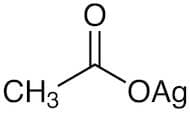
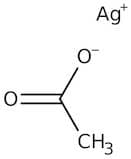
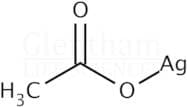
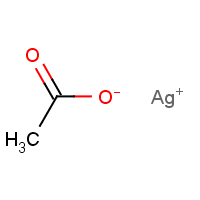
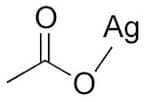
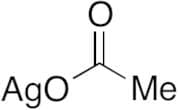
CAS 563-63-3
:Silver acetate
Description:
Silver acetate is an inorganic compound with the chemical formula AgC2H3O2. It appears as a white crystalline solid and is known for its solubility in water and organic solvents. This compound is characterized by its silver ion, which imparts antimicrobial properties, making it useful in various applications, including medicine and photography. Silver acetate can be synthesized through the reaction of silver nitrate with sodium acetate, resulting in the formation of silver acetate and sodium nitrate. It is important to handle silver acetate with care, as it can be toxic and may cause irritation upon contact with skin or eyes. In terms of stability, silver acetate is relatively stable under normal conditions but can decompose upon exposure to light or heat, releasing acetic acid and silver oxide. Its applications extend to organic synthesis, where it serves as a reagent in various chemical reactions, including the preparation of other silver compounds. Overall, silver acetate is a versatile compound with significant importance in both industrial and laboratory settings.
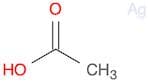
Formula:C2H4O2·Ag
InChI:InChI=1S/C2H4O2.Ag/c1-2(3)4;/h1H3,(H,3,4);
InChI key:InChIKey=QSDSNNSKORVORL-UHFFFAOYSA-N
SMILES:C(C)(O)=O.[Ag]
Synonyms:- Acetate d'argent
- Acetate, Silver (I)
- Acetato De Plata
- Acetic acid, silver(1+) salt (1:1)
- Argentous acetate
- Silberacetat
- Silver Acetate
- Silver acetate (AgOAc)
- Silver monoacetate
- Silver(1+) acetate
- Silver(I) acetate
- Acetic acid, silver (1+) salt
- See more synonyms
Sort by
Purity (%)
0
100
|
0
|
50
|
90
|
95
|
100
Found 11 products.
Silver(I) Acetate
CAS:Formula:C2H3AgO2Purity:>95.0%(T)Color and Shape:White to Almost white powder to crystalMolecular weight:166.91Silver acetate, anhydrous, 99%
CAS:It is a reagent in the laboratory as a source of silver ions lacking an oxidizing anion. It is a reagent for direct ortho-arylation, and for conversion of organohalogen compounds into alcohols. Woodward cis-hydroxylation reaction employs silver acetate and iodine for selective conversin of alkeneFormula:C2H3AgO2Purity:99%Color and Shape:White to cream, Microcrystalline powder or powderMolecular weight:166.91Silver acetate, 99%
CAS:Silver acetate, 99%
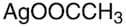
Formula:AgOOCCH3Purity:99%Color and Shape:off-white pwdr.Molecular weight:166.92Silver acetate, anhydrous, 99.5%
CAS:Formula:C2H3AgO2Purity:≥ 99.5%Color and Shape:White to off-white crystalline powderMolecular weight:166.92Silver acetate
CAS:Silver acetateFormula:·C2H3O2·AgPurity:99%Color and Shape: off white to faint grey solidMolecular weight:166.91g/molSilver acetate, 99+%
CAS:Formula:AgOOCCH3Purity:≥ 99.0%Color and Shape:White, off-white or faint grey crystalline powder or crystalsMolecular weight:166.92Silver acetate, 99.99%
CAS:Formula:AgOOCCH3Purity:≥ 99.99%Color and Shape:White to off-white of pale grey crystalline powder or crystalsMolecular weight:166.92Silver Acetate pure, 98%
CAS:Formula:C2H3AgO2Purity:min. 98.0%Color and Shape:Off-white to greyish, PowderMolecular weight:166.92Silver(I) acetate
CAS:Formula:C2H3AgO2Purity:98%Color and Shape:Solid, Off-white powderMolecular weight:166.912Silver Acetate
CAS:Controlled ProductApplications Silver Acetate is used as a reagent in chemical synthesis in reaction such as carbonylation of primary and secondary amines as well as in woodward cis-hydroxylation converting alkenes into cis-diols. Also used in gum, lonzenges and sprays that are targeted to assist people in quitting the habit of smoking since it produces a bad taste when combined with cigarettes.
Not a dangerous good if item is equal to or less than 1g/ml and there is less than 100g/ml in the package
References Wright, L., et al.: J. Phys. Chem., 59, 1060 (1955); Woodward, R., et al.: J. Am. Chem. Soc., 80, 209 (1958); Lancaster, T., et al.: Cochrane DB Syst. Rev., 2, 191 (2000);Formula:C2H3AgO2Color and Shape:NeatMolecular weight:166.91