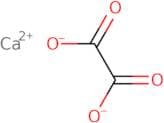
CAS 563-72-4
:Ethanedioic acid, calcium salt (1:1)
Description:
Ethanedioic acid, calcium salt (1:1), commonly known as calcium oxalate, is an inorganic compound with the formula CaC2O4. It typically appears as a white crystalline solid and is insoluble in water, which makes it relevant in various biological and geological contexts. Calcium oxalate is found naturally in many plants and is a component of kidney stones in humans. The compound can exist in several forms, including monohydrate and dehydrate, each with distinct physical properties. It is often used in agriculture as a calcium supplement and in the food industry, where it can influence the nutritional content of certain foods. In terms of safety, calcium oxalate can be toxic in large quantities, particularly when ingested, leading to potential health issues. Its formation in the body can also indicate metabolic disorders. Overall, calcium oxalate plays a significant role in both environmental and biological systems, highlighting its importance in chemistry and health sciences.
Formula:C2H2O4·Ca
InChI:InChI=1S/C2H2O4.Ca/c3-1(4)2(5)6;/h(H,3,4)(H,5,6);
InChI key:InChIKey=XJHLJVVLRQXMQI-UHFFFAOYSA-N
SMILES:C(C(O)=O)(O)=O.[Ca]
Synonyms:- Unii-2612Hc57Ye
- Calcium oxalate (1:1)
- Ethanedioic acid, calcium salt (1:1)
- Oxalic acid, calcium salt (1:1)
- Calcium Ethanedioate
- Calciumoxalat
- Oxalate de calcium
- Oxalate, Calcium
- Oxalato De Calcio
- MeSH ID: D002129
Sort by
Purity (%)
0
100
|
0
|
50
|
90
|
95
|
100
Found 1 products.
Calcium oxalate
CAS:Calcium oxalate is a crystal that can be found in plants and animals. It is used as a model system to study cell death. Calcium oxalate crystals are inert, but when they react with other substances, they create reactive calcium oxalate crystals that can kill cells by caspase-independent cell death. The crystals also cause cell lysis and are a potential candidate for chemoattractant proteins. Calcium oxalates have been shown to induce phase transition at temperatures below the boiling point of water, which may lead to pharmacological treatments for osteoporosis or kidney stones.Formula:CaC2O4Purity:Min. 95%Molecular weight:128.1 g/mol