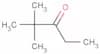
CAS 564-04-5
:2,2-Dimethyl-3-pentanone
Description:
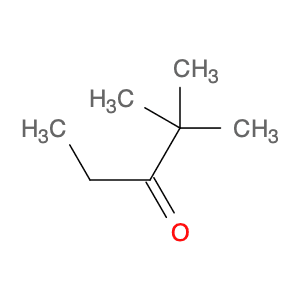
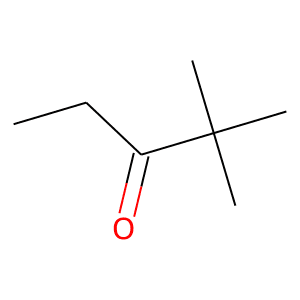
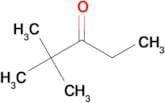
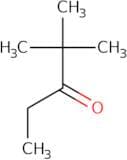
2,2-Dimethyl-3-pentanone, with the CAS number 564-04-5, is a ketone characterized by its branched structure, which contributes to its unique chemical properties. It has a molecular formula of C7H14O and features a carbonyl group (C=O) located at the third carbon of a five-carbon chain, flanked by two methyl groups at the second carbon. This configuration results in a colorless liquid with a distinctive odor, often described as sweet or fruity. The compound is soluble in organic solvents and exhibits moderate polarity due to the presence of the carbonyl group. It has a relatively low boiling point compared to other ketones, making it volatile. 2,2-Dimethyl-3-pentanone is used in various applications, including as a solvent and in the synthesis of other organic compounds. Its reactivity includes typical ketone reactions, such as nucleophilic addition and oxidation. Safety considerations include handling it in well-ventilated areas and using appropriate personal protective equipment, as it may pose health risks upon inhalation or skin contact.
Formula:C7H14O
InChI:InChI=1/C7H14O/c1-5-6(8)7(2,3)4/h5H2,1-4H3
SMILES:CCC(=O)C(C)(C)C
Synonyms:- 3-Pentanone, 2,2-dimethyl-
- 2,2-Dimethylpentan-3-One
Sort by
Purity (%)
0
100
|
0
|
50
|
90
|
95
|
100
Found 4 products.
2,2-Dimethylpentan-3-one
CAS:2,2-Dimethylpentan-3-oneFormula:C7H14OPurity:≥95%Color and Shape: clear. almost colourless liquidMolecular weight:114.19g/mol2,2-Dimethylpentan-3-one
CAS:Purity:95.0%Color and Shape:Liquid, No data available.Molecular weight:114.188003540039062,2-Dimethylpentan-3-one
CAS:2,2-Dimethylpentan-3-one is an enolate that is used as a synthetic intermediate in the synthesis of aldehydes. The optical and stereoselective properties of 2,2-dimethylpentan-3-one are due to its chiral center, which can be either R or S depending on the substituent effects. In this compound, the substituents are chloride and methoxy groups. These substituents have opposite effects on the reactivity in the molecule's enolate form. When chloride is present, it occupies an axial position with respect to the carbonyl group and therefore has a stabilizing effect on the molecule; this leads to lower reactivity. Methoxy groups occupy equatorial positions and have a destabilizing effect on the molecule by withdrawing electron density from its carbonyl group; this leads to higher reactivity.Formula:C7H14OPurity:Min. 95%Molecular weight:114.19 g/mol