CAS 56539-85-6
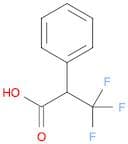
:3,3,3-trifluoro-2-phenylpropanoic acid
Description:
3,3,3-Trifluoro-2-phenylpropanoic acid is an organic compound characterized by the presence of a trifluoromethyl group and a phenyl group attached to a propanoic acid backbone. Its molecular structure features three fluorine atoms bonded to the carbon atom at the alpha position relative to the carboxylic acid functional group, which significantly influences its chemical properties, including increased acidity and lipophilicity. The presence of the phenyl group contributes to its aromatic characteristics and can affect its reactivity and interactions with biological systems. This compound is typically a white solid at room temperature and is soluble in organic solvents, while its solubility in water is limited due to the hydrophobic nature of the phenyl group. 3,3,3-Trifluoro-2-phenylpropanoic acid is of interest in various fields, including medicinal chemistry and materials science, due to its potential applications in drug development and as a building block for synthesizing other fluorinated compounds. Safety data should be consulted for handling and storage, as fluorinated compounds can exhibit unique toxicological profiles.
Formula:C9H7F3O2
InChI:InChI=1/C9H7F3O2/c10-9(11,12)7(8(13)14)6-4-2-1-3-5-6/h1-5,7H,(H,13,14)
SMILES:c1ccc(cc1)C(C(=O)O)C(F)(F)F
Sort by
Purity (%)
0
100
|
0
|
50
|
90
|
95
|
100
Found 3 products.
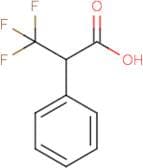
(2R)-3,3,3-trifluoro-2-phenylpropanoic acid
CAS:Formula:C9H7F3O2Purity:97%Color and Shape:SolidMolecular weight:204.14593,3,3-Trifluoro-2-phenylpropionic acid
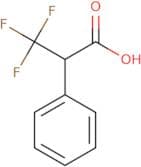
CAS:3,3,3-Trifluoro-2-phenylpropionic acidFormula:C9H7F3O2Purity:≥95%Color and Shape: off-white powderMolecular weight:204.15g/mol3,3,3-Trifluoro-2-phenylpropionic acid
CAS:3,3,3-Trifluoro-2-phenylpropionic acid (TFPA) is a chiral molecule that can be used as a derivatizing agent to identify compounds. It has antibacterial properties and may be used in the manufacture of thin films or coatings. TFPA is insoluble in water and exhibits antibacterial activity when applied to surfaces. This compound can also be used in the synthesis of perovskite solar cells, as well as for particle size measurements. TFPA reacts with alcohols and amides to form esters and amides respectively. TFPA is also reactive with phosphines such as triphenylphosphine to form phosphonium salts. TFPA has been shown to have anti-inflammatory effects in mice by inhibiting prostaglandin synthesis.Formula:C9H7F3O2Purity:Min. 95%Molecular weight:204.15 g/mol