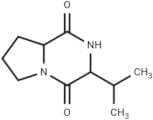
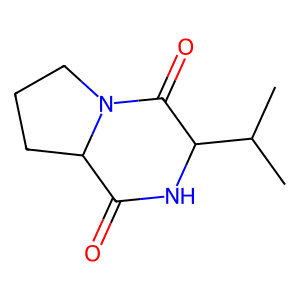
![3-(propan-2-yl)hexahydropyrrolo[1,2-a]pyrazine-1,4-dione](/_next/image/?url=https%3A%2Fstatic.cymitquimica.com%2Fcas-image%2Fthumb-webp%2F316750-3-propan-2-yl-hexahydropyrrolo-12-a-pyrazine-14-dione.webp&w=3840&q=75)
CAS 5654-87-5
:3-(propan-2-yl)hexahydropyrrolo[1,2-a]pyrazine-1,4-dione
Description:
3-(Propan-2-yl)hexahydropyrrolo[1,2-a]pyrazine-1,4-dione, with the CAS number 5654-87-5, is a chemical compound characterized by its unique bicyclic structure, which includes a pyrazine ring fused to a pyrrolidine moiety. This compound features a hexahydropyrrolo framework, indicating that it contains a saturated nitrogen-containing ring system. The presence of the isopropyl group (propan-2-yl) contributes to its hydrophobic characteristics, influencing its solubility and reactivity. The dione functional groups (1,4-dione) suggest that the compound can participate in various chemical reactions, including nucleophilic additions and condensation reactions. Its structural complexity may impart interesting biological activities, making it a subject of interest in medicinal chemistry and drug development. Additionally, the compound's stability and reactivity can be affected by environmental factors such as pH and temperature, which are crucial for its applications in synthesis and potential therapeutic uses. Overall, this compound exemplifies the diverse chemistry associated with nitrogen-containing heterocycles.
Formula:C10H16N2O2
InChI:InChI=1/C10H16N2O2/c1-6(2)8-10(14)12-5-3-4-7(12)9(13)11-8/h6-8H,3-5H2,1-2H3,(H,11,13)
SMILES:CC(C)C1C(=O)N2CCCC2C(=N1)O
Synonyms:- Cyclo(Prolyl-Valyl)
Sort by
Purity (%)
0
100
|
0
|
50
|
90
|
95
|
100
Found 4 products.
Cyclo(Pro-Val)
CAS:Cyclo(Pro-Val), a marine fungus derivative, exhibits moderate antifungal and weak antitumor effects; MIC of 0.8 g/L against Bacillus subtilis.
Formula:C10H16N2O2Purity:99.86%Color and Shape:SolidMolecular weight:196.25Cyclo-Val-Pro-diketopiperazine
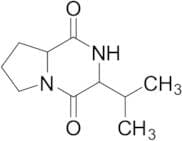
CAS:Cyclo-Val-Pro-diketopiperazine is a drug that inhibits the growth of colon cancer cells by inducing apoptosis. It has been shown to have an inhibitory effect on the proliferation of p. aeruginosa and other bacteria, which may be due to its ability to interfere with DNA replication. Cyclo-Val-Pro-diketopiperazine also induces tumor cell apoptosis in vitro. The mechanism for this is not yet known, but it may involve interference with mitochondrial membrane potential or inhibition of acetate extraction from colonic cells. In addition, this drug has been shown to induce apoptosis in colorectal adenocarcinoma cells by causing an increase in reactive oxygen species and a decrease in mitochondrial membrane potential. Cyclo-Val-Pro-diketopiperazine can cause an increase in the levels of acetate extractable from caco2 cells as well as a decrease in mitochondrial membrane potential, which are bothFormula:C10H16N2O2Purity:Min. 95%Color and Shape:PowderMolecular weight:196.25 g/molCyclo-Val-Pro-diketopiperazine
CAS:Controlled ProductFormula:C10H16N2O2Color and Shape:NeatMolecular weight:196.246