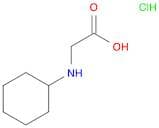
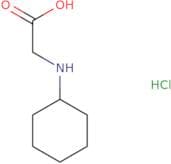
CAS 56676-70-1
:N-cyclohexylglycine hydrochloride (1:1)
Description:
N-cyclohexylglycine hydrochloride (1:1) is a chemical compound characterized by its structure, which includes a cyclohexyl group attached to a glycine moiety, with the hydrochloride form indicating the presence of hydrochloric acid in its salt form. This compound typically appears as a white crystalline solid and is soluble in water, which is a common trait for many amino acid derivatives. It is often utilized in biochemical research and pharmaceutical applications due to its potential role as a neurotransmitter or in modulating receptor activity. The presence of the cyclohexyl group may influence its lipophilicity and biological activity, making it of interest in medicinal chemistry. As with many hydrochloride salts, it is generally stable under standard conditions but should be stored in a cool, dry place to maintain its integrity. Safety data sheets should be consulted for handling and toxicity information, as with any chemical substance.
Formula:C8H16ClNO2
InChI:InChI=1/C8H15NO2.ClH/c10-8(11)6-9-7-4-2-1-3-5-7;/h7,9H,1-6H2,(H,10,11);1H
SMILES:C1CCC(CC1)NCC(=O)O.Cl
Synonyms:- glycine, N-cyclohexyl-, hydrochloride (1:1)
- H-D-Chg-Oh Hcl
- D-Cyclohexyl glycine hydrochloride
Sort by
Purity (%)
0
100
|
0
|
50
|
90
|
95
|
100
Found 3 products.
2-(Cyclohexylamino)acetic acid hydrochloride
CAS:Formula:C8H16ClNO2Purity:96%Molecular weight:193.67112-(Cyclohexylamino)acetic acid hydrochloride
CAS:2-(Cyclohexylamino)acetic acid hydrochloride is a chiral compound that has been shown to inhibit the activity of metalloproteinases, including matrix metalloproteinase (MMP) and peptidyl-arginine deiminases. It also inhibits the production of inflammatory cytokines in response to viral infection. 2-(Cyclohexylamino)acetic acid hydrochloride may be useful for the treatment of liver diseases such as hepatitis or cirrhosis due to its ability to inhibit MMP-2. It is also being investigated as a potential drug for traumatic brain injury because it has been shown to reduce oxidative stress and inflammation in animal models.Formula:C8H16ClNO2Purity:Min. 95%Molecular weight:193.67 g/molRef: 3D-GCA67670
Discontinued product