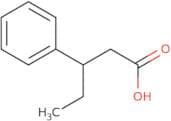
CAS 5669-17-0
:β-Ethylbenzenepropanoic acid
Description:
β-Ethylbenzenepropanoic acid, with the CAS number 5669-17-0, is an organic compound characterized by its structure, which features a propanoic acid group attached to a β-ethylbenzene moiety. This compound typically exhibits properties common to carboxylic acids, including the ability to form hydrogen bonds, which contributes to its solubility in polar solvents. It may appear as a colorless to pale yellow liquid or solid, depending on its purity and specific conditions. The presence of the ethyl group and the aromatic benzene ring can influence its reactivity and stability, making it a potential candidate for various chemical reactions, including esterification and acylation. Additionally, β-Ethylbenzenepropanoic acid may have applications in organic synthesis and as an intermediate in the production of pharmaceuticals or agrochemicals. Its physical and chemical properties, such as melting point, boiling point, and reactivity, can vary based on the specific conditions and purity of the sample. Safety data should be consulted for handling and storage guidelines.
Formula:C11H14O2
InChI:InChI=1S/C11H14O2/c1-2-9(8-11(12)13)10-6-4-3-5-7-10/h3-7,9H,2,8H2,1H3,(H,12,13)
InChI key:InChIKey=NJEKDDOCPZKREE-UHFFFAOYSA-N
SMILES:C(CC(O)=O)(CC)C1=CC=CC=C1
Synonyms:- .alpha.-Ethyl-hydrocinnamic acid
- 3-Phenylvaleric acid
- Benzenepropanoic Acid, Beta-Ethyl-
- Benzenepropanoic acid, β-ethyl-
- Hydrocinnamic acid, β-ethyl-
- NSC 30122
- Pentanoic acid, 3-phenyl-
- β-Ethylbenzenepropanoic acid
- 3-Phenylpentanoic acid
Sort by
Purity (%)
0
100
|
0
|
50
|
90
|
95
|
100
Found 1 products.
3-phenylpentanoic acid
CAS:3-phenylpentanoic acid is an impurity of 2-phenylbutyric acid, which is used in the synthesis of some pharmaceuticals. It is also an optical isomer of 3-phenylpropanoic acid. The compound has been shown to inhibit the growth of pseudomonas strains and may be useful in the treatment of neurotoxicity. The precise mechanism by which 3-phenylpentanoic acid inhibits bacterial growth is not known, but it has been speculated that it may inhibit the synthesis of proteins, RNA, or DNA. This compound can be synthesized chemoenzymatically from 2-phenylethyl esters and proton donors, such as ethylene glycol and formaldehyde. The enantiomers can be separated by chiral HPLC.
Formula:C11H14O2Purity:Min. 95%Molecular weight:178.22 g/mol