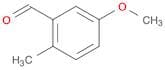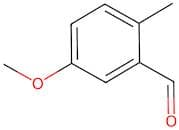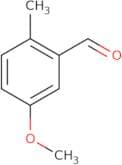
CAS 56724-09-5
:Benzaldehyde, 5-methoxy-2-methyl-
Description:
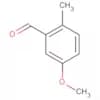
Benzaldehyde, 5-methoxy-2-methyl- is an organic compound characterized by its aromatic structure, featuring a benzene ring with a formyl group (-CHO) and additional substituents, specifically a methoxy group (-OCH3) and a methyl group (-CH3). This compound is typically a colorless to pale yellow liquid with a pleasant almond-like odor, which is characteristic of benzaldehyde derivatives. It is soluble in organic solvents such as ethanol and ether but has limited solubility in water due to its hydrophobic nature. The presence of the methoxy and methyl groups can influence its reactivity and polarity, making it a useful intermediate in organic synthesis and a potential flavoring agent in the food industry. Additionally, it may exhibit biological activity, which could be of interest in pharmaceutical applications. As with many aromatic compounds, it should be handled with care due to potential toxicity and environmental impact.
Formula:C9H10O2
Synonyms:- 5-Methoxy-2-methylbenzaldehyde
Sort by
Purity (%)
0
100
|
0
|
50
|
90
|
95
|
100
Found 4 products.
5-Methoxy-2-methylbenzaldehyde
CAS:Formula:C9H10O2Purity:98%Color and Shape:LiquidMolecular weight:150.17455-Methoxy-2-Methylbenzaldehyde
CAS:5-Methoxy-2-MethylbenzaldehydePurity:98%Molecular weight:150.17g/mol5-Methoxy-2-methylbenzaldehyde
CAS:Formula:C9H10O2Purity:98%Color and Shape:Liquid, ClearMolecular weight:150.1775-Methoxy-2-methylbenzaldehyde
CAS:5-Methoxy-2-methylbenzaldehyde is a piperazine derivative that is used in the synthesis of other organic compounds. It is an intermediate for the production of fluoroquinolones, which are broad spectrum antibiotics. 5-Methoxy-2-methylbenzaldehyde can be synthesized using the liquid phase technique, which involves the use of solvents such as chloroform and ethanol. It has two isomers, methoxy methyl and methoxymethyl, which can be separated by chromatography or mass spectrometry. The synthesis of 5-methoxy-2-methylbenzaldehyde starts with a reaction between trimethylamine and formaldehyde in concentrated sulfuric acid. This reaction produces diethyl fumarate, which reacts with hydrochloric acid to produce diethyl malonate. The next step in this process involves heating the malonate mixture to produce 5-methoxy-2-methylbenzFormula:C9H10O2Purity:Min. 95%Molecular weight:150.18 g/mol