CAS 56891-59-9
:N-(4-amino-2-methylphenyl)acetamide
Description:
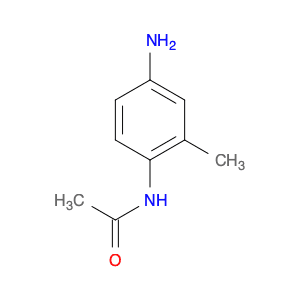
N-(4-amino-2-methylphenyl)acetamide, also known as 4-amino-2-methylacetanilide, is an organic compound characterized by its amide functional group and an aromatic ring. It features an amino group (-NH2) and an acetamide group (-C(=O)NH2) attached to a substituted phenyl ring. This compound typically appears as a solid at room temperature and is soluble in polar solvents such as water and alcohols, owing to its ability to form hydrogen bonds. Its molecular structure contributes to its potential applications in pharmaceuticals, particularly as an intermediate in the synthesis of various drugs. The presence of the amino group enhances its reactivity, making it a useful building block in organic synthesis. Additionally, it may exhibit biological activity, which warrants further investigation in medicinal chemistry. Safety data should be consulted for handling and exposure guidelines, as with any chemical substance. Overall, N-(4-amino-2-methylphenyl)acetamide is a compound of interest in both industrial and research settings.
Formula:C9H12N2O
InChI:InChI=1/C9H12N2O/c1-6-5-8(10)3-4-9(6)11-7(2)12/h3-5H,10H2,1-2H3,(H,11,12)
SMILES:Cc1cc(ccc1N=C(C)O)N
Synonyms:- Acetamide, N-(4-amino-2-methylphenyl)-
Sort by
Purity (%)
0
100
|
0
|
50
|
90
|
95
|
100
Found 4 products.
N1-(4-AMINO-2-METHYLPHENYL)ACETAMIDE
CAS:Formula:C9H12N2OPurity:95%Color and Shape:SolidMolecular weight:164.20444'-Amino-2'-methylacetanilide
CAS:4'-Amino-2'-methylacetanilideFormula:C9H12N2OPurity:≥95%Color and Shape: faint brown powderMolecular weight:164.20g/molN-(4-Amino-2-methylphenyl)acetamide
CAS:4-Amino-2-methylphenylacetic acid (AMPA) is a chemical compound that has been used in the treatment of skin disorders. AMPA is not active when applied to the skin, but it can be converted to 4-amino-2-methylphenylacetamide (AMPAA), which is an effective treatment for psoriasis. This conversion can be achieved with keratinocyte cells, which are found in the outer layer of skin. The optimal conditions for this conversion include coculturing keratinocytes and thp-1 cells over a period of 48 hours. This process was demonstrated using a human keratinocyte cell line and thp-1 cells. The sensitivity of these cells to AMPA was tested by exposing them to increasing concentrations of AMPA until they were killed. The results showed that AMPA had no effect on keratinocyte cells, but at higher concentrations it had an adverse effect on thp-1 cells. It was alsoFormula:C9H12N2OPurity:Min. 95%Molecular weight:164.21 g/mol