CAS 5707-55-1
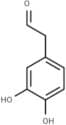
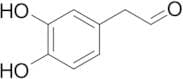
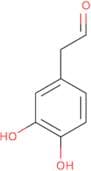
:(3,4-Dihydroxyphenyl)acetaldehyde
- 2-(3,4-Dihydroxyphenyl)acetaldehyde
- 3,4-Dihydroxy-α-tolualdehyde
- 3,4-Dihydroxybenzeneacetaldehyde
- Acetaldehyde, (3,4-dihydroxyphenyl)-
- Benzeneacetaldehyde, 3,4-Dihydroxy-
- Dopal
- Homoprotocatechualdehyde
- (3,4-Dihydroxyphenyl)acetaldehyde
DOPAL
CAS:DOPAL, a neurotoxic aldehyde from dopamine metabolism, is linked to Parkinson's and can convert to DOPAC or DOPET.Formula:C8H8O3Color and Shape:SolidMolecular weight:152.15Dopal (>80%)
CAS:Controlled ProductStability Air Sensitive, Hygroscopic
Applications Dopal is a product of Dopamine (CAT# D533780) catabolism by monoamine oxidase and may be further oxidized to 3,4-Dihydroxyphenylacetic Acid (CAT# D454250) via aldehyde dehydrogenase. DOPAL can also be reduced to Hydroxy Tyrosol (CAT# H977000) via cytosolic aldehyde or aldose reductase. DOPAL is harmful to nigrostriatal DA terminals and contributes to the profound putamen DA deficiency found in Parkinson's disease. Cytosolic and mitochondrial aldehyde dehydrogenase (ALDH) isoenzymes deficiency in mice results in increased levels of DOPAL, causing neurodegeneration and motor dysfunction also associated with Parkinson's disease.
References Jinsmaa, Y., et al.: Chem. Res. Toxicol., 22, 835 (2009); Goldstein, D. S., et al.: J. Neurochem., 126, 591 (2013); Panneton, W. M., et al.: PLoS One, 5, e15251 (2010); Wey, M. C., et al.: PLoS One, 7, e31522 (2012)Formula:C8H8O3Purity:>80%Color and Shape:Light Brown To Dark BrownMolecular weight:152.152-(3,4-Dihydroxyphenyl)acetaldehyde
CAS:Please enquire for more information about 2-(3,4-Dihydroxyphenyl)acetaldehyde including the price, delivery time and more detailed product information at the technical inquiry form on this page
Formula:C8H8O3Purity:Min 80%Molecular weight:152.15 g/mol