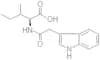
CAS 57105-45-0
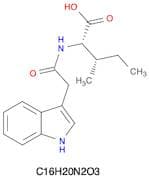
:N-(3-indolylacetyl)-L-isoleucine
Description:
N-(3-indolylacetyl)-L-isoleucine, with the CAS number 57105-45-0, is a synthetic compound that belongs to the class of amino acid derivatives. It features an indole ring, which is a bicyclic structure known for its aromatic properties, attached to an acetyl group and the amino acid isoleucine. This compound exhibits characteristics typical of both amino acids and indole derivatives, including potential biological activity. It may participate in various biochemical pathways, possibly influencing protein synthesis or acting as a signaling molecule. The presence of the indole moiety suggests potential interactions with biological receptors or enzymes, making it of interest in pharmacological research. Additionally, its structural configuration allows for specific stereochemistry, which can affect its biological activity and interactions. As with many amino acid derivatives, it may exhibit solubility in polar solvents and could be sensitive to changes in pH. Overall, N-(3-indolylacetyl)-L-isoleucine represents a unique intersection of amino acid chemistry and indole pharmacology, warranting further investigation into its properties and applications.
Formula:C16H20N2O3
InChI:InChI=1/C16H20N2O3/c1-3-10(2)15(16(20)21)18-14(19)8-11-9-17-13-7-5-4-6-12(11)13/h4-7,9-10,15,17H,3,8H2,1-2H3,(H,18,19)(H,20,21)
SMILES:CCC(C)C(C(=O)O)N=C(Cc1c[nH]c2ccccc12)O
Synonyms:- N-(1H-indol-3-ylacetyl)-L-isoleucine
- N-(1H-indol-3-ylacetyl)isoleucine
Sort by
Purity (%)
0
100
|
0
|
50
|
90
|
95
|
100
Found 6 products.
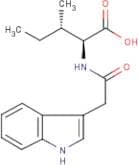
(2S,3S)-2-(2-(1H-Indol-3-yl)acetamido)-3-methylpentanoic acid
CAS:Formula:C16H20N2O3Purity:95%Molecular weight:288.3416Indole-3-acetyl-L-isoleucine
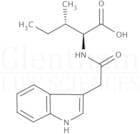
CAS:Please enquire for more information about Indole-3-acetyl-L-isoleucine including the price, delivery time and more detailed product information at the technical inquiry form on this pageFormula:C16H20N2O3Molecular weight:288.35 g/molIndole-3-acetyl-L-isoleucine
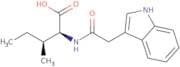
CAS:Indole-3-acetyl-L-isoleucine (IAIL) is a conjugate that has been shown to inhibit virus-induced gene expression in cultured cells. IAIL also functions to inhibit the growth of periodontal disease bacteria, such as Porphyromonas gingivalis, by interfering with the synthesis of bacterial cell wall components and by inhibiting the biosynthesis of indole-3-acetyl-l-aspartic acid. It is synthesized from indole-3-acetyl-l-aspartic acid and L-isoleucine by an enzyme called 3'5'-cyclic AMP synthase. The IAIL sequence has been found in plants, fungi, and animals.
Formula:C16H20N2O3Color and Shape:PowderMolecular weight:288.34 g/mol