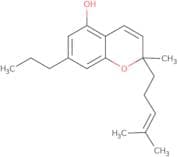
CAS 57130-04-8
:Cannabichromevarin
Description:
Cannabichromevarin (CBCV) is a non-psychoactive cannabinoid found in cannabis plants, particularly in certain strains of hemp and marijuana. It is a member of the cannabinoid family, which includes compounds that interact with the endocannabinoid system in the human body. CBCV is structurally similar to cannabichromene (CBC) but differs by the presence of a propyl side chain instead of a pentyl chain. This structural variation influences its biological activity and potential therapeutic effects. Research suggests that CBCV may possess anti-inflammatory, analgesic, and neuroprotective properties, although studies are still ongoing to fully understand its pharmacological profile. Like other cannabinoids, CBCV is believed to interact with cannabinoid receptors, potentially modulating various physiological processes. Its low abundance in cannabis makes it less studied compared to more prevalent cannabinoids like THC and CBD, but interest in CBCV is growing due to its potential health benefits and unique properties. As research continues, CBCV may offer new insights into the therapeutic applications of cannabinoids.
Formula:C19H26O2
InChI:InChI=1/C19H26O2/c1-5-7-15-12-17(20)16-9-11-19(4,21-18(16)13-15)10-6-8-14(2)3/h8-9,11-13,20H,5-7,10H2,1-4H3
InChI key:InChIKey=AAXZFUQLLRMVOG-UHFFFAOYNA-N
SMILES:OC1=C2C(OC(CCC=C(C)C)(C)C=C2)=CC(CCC)=C1
Synonyms:- 2H-1-Benzopyran-5-ol, 2-methyl-2-(4-methyl-3-penten-1-yl)-7-propyl-, (+)-
- 2H-1-Benzopyran-5-ol, 2-methyl-2-(4-methyl-3-pentenyl)-7-propyl-, (+)-
- CBC-V
- (+)-2-Methyl-2-(4-methyl-3-penten-1-yl)-7-propyl-2H-1-benzopyran-5-ol
- Cannabichromevarin
- (+)-2-Methyl-2-(4-methyl-3-pentenyl)-7-propyl-2H-1-benzopyran-5-ol
Sort by
Purity (%)
0
100
|
0
|
50
|
90
|
95
|
100
Found 1 products.
Cannabichromevarin
CAS:Controlled ProductCannabichromevarin is a phytocannabinoid naturally found in very low levels compared to other cannabinoids from which it differs in having a propyl chain in place of a pentyl chain1. Based on its structure, it is believed to act as a potent anandamine inhibitor similarly to cannabichromene, however, the majority of its pharmacological and toxicological properties are currently unknown. In vitro assays have shown cannabichromevarin protect against oxidative stress in vitro in macrophages2. It was recently shown to be effective for treatment-resistant epilepsy in a patented combination with cannabidiol in a recent open-ended clinical trial3.
Formula:C19H26O2Purity:Min. 95%Molecular weight:286.41 g/molRef: 3D-BC177464
Discontinued product