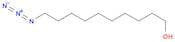
CAS 57395-48-9
:10-Azido-1-decanol
Description:
10-Azido-1-decanol is a chemical compound characterized by the presence of an azide functional group (-N3) attached to a decanol backbone, specifically at the terminal position. This compound is typically a colorless to pale yellow liquid at room temperature and is soluble in organic solvents, while its solubility in water is limited due to the hydrophobic nature of the decanol chain. The azide group introduces unique reactivity, making it useful in various synthetic applications, particularly in click chemistry, where it can participate in cycloaddition reactions. The presence of the long hydrocarbon chain contributes to its lipophilicity, influencing its interactions with biological membranes and potential applications in drug delivery or as a surfactant. However, due to the inherent instability of azides, particularly under heat or shock, handling precautions are necessary to mitigate risks associated with their explosive nature. Overall, 10-Azido-1-decanol serves as a versatile intermediate in organic synthesis and materials science.
Formula:C10H21N3O
InChI:InChI=1S/C10H21N3O/c11-13-12-9-7-5-3-1-2-4-6-8-10-14/h14H,1-10H2
InChI key:InChIKey=VSOCJQSZRBCJET-UHFFFAOYSA-N
SMILES:C(CCCCN=[N+]=[N-])CCCCCO
Synonyms:- 10-Azido-1-decanol
- 1-Decanol, 10-azido-
Sort by
Purity (%)
0
100
|
0
|
50
|
90
|
95
|
100
Found 4 products.
10-Azido-1-decanol
CAS:10-Azido-1-decanol is a non-polar solvent with reactive properties. It has been shown to cause cellular damage in proton and 6-chloropurine, which is a precursor for the synthesis of nucleic acids. 10-Azido-1-decanol has been used as an ultraviolet light absorber in strategies to protect tissues from ultraviolet light and it can also be used to study the effects of functional groups on optical properties. 10-Azido-1-decanol's hypochromic behavior makes it useful in bilayer studies because it can be easily distinguished from other solvents or water molecules.Formula:C10H21N3OPurity:Min. 95%Color and Shape:Clear LiquidMolecular weight:199.29 g/mol10-Azido-1-decanol
CAS:Controlled ProductApplications 10-Azido-1-decanol (cas# 57395-48-9) is a compound useful in organic synthesis.
Formula:C10H21N3OColor and Shape:NeatMolecular weight:199.29