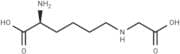
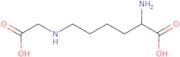
CAS 5746-04-3
:Nε-(Carboxymethyl)lysine
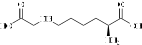
- (2S)-2-Amino-6-(carboxymethylamino)hexanoic acid
- <span class="text-smallcaps">L</span>-Lysine, N<sup>6</sup>-(carboxymethyl)-
- L-Lysine,N6-(carboxymethyl)-
- Lysine, N<sup>6</sup>-(carboxymethyl)-, <span class="text-smallcaps">L</span>-
- Lysine,N6-(carboxymethyl)-, L- (8CI)
- N-(3-chloro-4-fluorophenyl)-2-[(2-chlorophenyl)sulfanyl]acetamide
- N6-(1-Carboxymethyl)-L-lysine
- N6-(Carboxymethyl)lysine
- N<sup>6</sup>-(Carboxymethyl)-<span class="text-smallcaps">L</span>-lysine
- N<sup>6</sup>-(Carboxymethyl)lysine
- N<sup>ε</sup>-(Carboxymethyl)lysine
- Ne-(Carboxymethyl)lysine
- e-(Carboxymethyl)lysine
- N6-(Carboxymethyl)-L-lysine
- See more synonyms
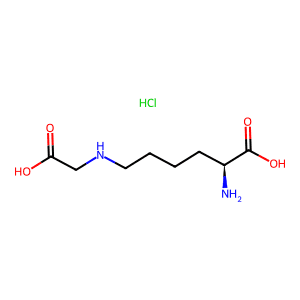
(2S)-2-Amino-6-(carboxymethylamino)hexanoic acid hydrochloride
CAS:(2S)-2-Amino-6-(carboxymethylamino)hexanoic acid hydrochloridePurity:95%Color and Shape:SolidMolecular weight:240.68g/molNε-(1-Carboxymethyl)-L-lysine
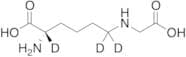
CAS:Formula:C8H16N2O4Purity:>95.0%(GC)Color and Shape:White to Light yellow powder to crystalMolecular weight:204.23NEpsilon-(Carboxymethyl)-L-lysine-2,6,6-d3
CAS:Controlled ProductFormula:C8H13D3N2O4Color and Shape:NeatMolecular weight:207.24Nε-(1-Carboxymethyl)-L-lysine
CAS:Applications CEL and CML are two stable, nonenzymatic chemical modifications of protein lysine residues resulting from glycation and oxidation reactions.
References Fu, M.X., et al.: J. Biol. Chem., 271, 9982 (1996), Ahmed M.U., et al.: Biochem.J., 324, 565 (1997), Schleicher, E.D., et al.: J. Clin. Invest., 99, 457 (1997), Shibayama, R., et al.: Diabetes, 48, 1842 (1999),Formula:C8H16N2O4Color and Shape:NeatMolecular weight:204.22(2S)-2-amino-6-[(carboxymethyl)amino]hexanoic acid
CAS:Formula:C8H16N2O4Purity:98%Color and Shape:White crystalline powderMolecular weight:204.226Nε-(1-Carboxymethyl)-L-lysine
CAS:Nε-(1-Carboxymethyl)-L-lysine (CML), an advanced glycation end product (AGE), is formed through the oxidative modification of glycated proteins under conditions of oxidative stress.1,2,3 Its levels escalate with age, diabetes, cancer, vascular diseases, and various pathologies associated with oxidative stress.1,4,5 CML interacts with the membrane-bound receptor for AGEs (RAGE), initiating signaling via MAPKs and NF-κB pathways. Conversely, a truncated version of RAGE generates a soluble protein that sequesters CML, thereby diminishing this signaling.6,7Formula:C8H16N2O4Color and Shape:SolidMolecular weight:204.2N-ε-(1-Carboxymethyl)-L-lysine
CAS:N-ε-(1-Carboxymethyl)-L-lysine (NEM) is a versatile building block that is used in the synthesis of complex compounds. It is a reagent and speciality chemical that can be used as an intermediate to produce other useful chemicals or as a reaction component. It has been shown to be useful in the synthesis of peptides, oligonucleotides, and organic molecules. NEM has also been shown to have high quality and purity, making it a useful scaffold for further research into new compounds.
Formula:C8H16N2O4Purity:Min. 97%Color and Shape:White PowderMolecular weight:204.22 g/mol
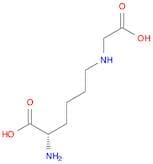







![(2S)-2-amino-6-[(carboxymethyl)amino]hexanoic acid](/_next/image/?url=https%3A%2Fstatic.cymitquimica.com%2Fproducts%2F10%2Fthumb%2FF402228.jpg&w=3840&q=75)